DDR2, also known as TYR010 and TKT, is a widely expressed 130 kDa type I transmembrane glycoprotein belonging to the discoidin-like domain containing subfamily of receptor tyrosine kinases. Mature human DDR2 consists of a 378 amino acid (aa) extracellular domain (ECD) that includes the discoidin-like domain, a 22 aa transmembrane segment, and a 434 aa cytoplasmic domain that includes the kinase domain. Within the ECD, human DDR2 shares 53% aa sequence identity with DDR1. It shares 97% and 96% aa sequence identity with mouse and rat DDR2, respectively. The discoidin-like domain mediates DDR2 interactions with collagens I, III, and X. Collagens II and V are less efficacious ligands. DDR2 selectively recognizes the triple helical structure of collagen compared to monomeric or denatured collagen. Within collagen II, the D2 period is required for DDR2 binding, while the D1 period is additionally required to trigger DDR2 autophosphorylation. The ECD of DDR2 exists as a noncovalent dimer in solution, and dimerization of the receptor greatly enhances collagen binding. DDR2 interaction with collagen I inhibits collagen fibrillogenesis and alters collagen fiber morphology. Ligand binding induces DDR2 autophosphorylation in the cytoplasmic domain, which promotes associations with Shc and Src. In addition to the above mechanism, DDR2 exhibits a distinct interaction with collagen X. A region other than the discoidin-like domain of DDR2 recognizes the non-helical NC1 domain of collagen X, and this interaction does not lead to receptor autophosphorylation. Activation of DDR2 by collagen induces up-regulation of MMP-1, -2, and -13 as well as DDR2 itself. DDR2 is implicated in collagenous matrix destruction and cell invasiveness. It promotes osteoblast and chondrocyte differentiation and supports ovulation and spermatogenesis. DDR2 is up-regulated in several pathological conditions, including hepatic fibrosis following injury, rheumatoid and osteoarthritis, and smooth muscle cell overgrowth diseases.
Post-translational: N-glycosylated. Tyrosine phosphorylated in response to collagen binding. Phosphorylated by SRC; this is required for activation and subsequent autophosphorylation on additional tyrosine residues.
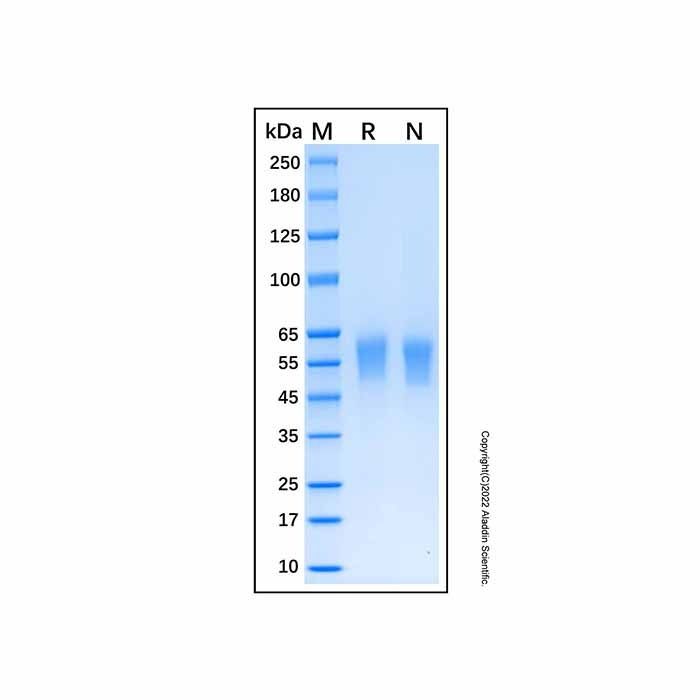
48.1-64.8 kDa, under reducing conditions; 48.1-64.8 kDa, under non-reducing conditions.
分子类型
蛋白质
产品线
生物产品
储存与运输
物理形态
冻干(Lyophilized)
储存缓冲液
Lyophilized from PBS, pH 7.4
复溶
We recommend that this vial be briefly centrifuged prior to opening to bring the contents to the bottom. Reconstitute at 1.0 mg/mL in sterile distilled water. Stock solutions should be apportioned into working aliquots and stored at ≤ -20 °C. Further dilutions should be made in appropriate buffered solutions.
储存条件
-20°C储存,避免反复冻融
运输条件
超低温运输
稳定性与储存
Store at -20°C for 1 year. Avoid freeze/thaw cycle.
图片
Recombinant Human DDR2 Protein (rp188240) - SDS-PAGE 3 μg/lane of Recombinant Human DDR2 Protein was resolved with SDS-PAGE under reducing (R) and non-reducing (N) conditions and visualized by Coomassie® Blue staining, showing a band at 48.1-64.8 kDa.

 ZJ24F1215405


 危险品化学品经营许可证(带存储)