Ornithine Decarboxylase/ODC1 is a pyridoxal phosphate (PLP)-dependent amino acid decarboxylase enzyme that catalyzes the conversion of ornithine into putrescine in a committed and rate-limiting step for polyamine synthesis. Each 51 kDa enzyme subunit contains a PLP-binding N-terminal domain and a C-terminal domain. Two active sites are formed through dimerization interfaces of the N- and C-terminal domains of opposing subunits. Although the enzymatically active form is homodimeric, the dimer is in rapid equilibrium due to weak association of the monomers and allows regulation of ODC1 activity through the binding of antizymes (Az) and antizyme inhibitors (AzIN) as regulatory proteins. ODC1 plays a crucial role in regulating polyamine levels associated with cell growth, proliferation, immunity, and differentiation. High levels of polyamines and ODC1 are associated with cancer. ODC1 is a gene target of the ras and myc oncogenes while also capable of regulating myc expression through putrescine production implicating its role as an oncogene in cancer. Mutation of ODC1 has also been shown to cause developmental delays in Bachman-Bupp syndrome. Consequently, ODC1 is a pharmacological target of interest in a growing number of applications such as in Bachman-Bupp Syndrome, iron deficiency and multiple cancers including osteosarcoma, neuroblastoma, breast, lung adenocarcinoma, hepatocellular carcinoma, and endometrial cancer.
Post-translational: S-Nitrosylation inhibits the enzyme. S-Nitrosylated in vitro on 4 cysteine residues.
Store at -20°C for 1 year. Avoid freeze/thaw cycle.
图片
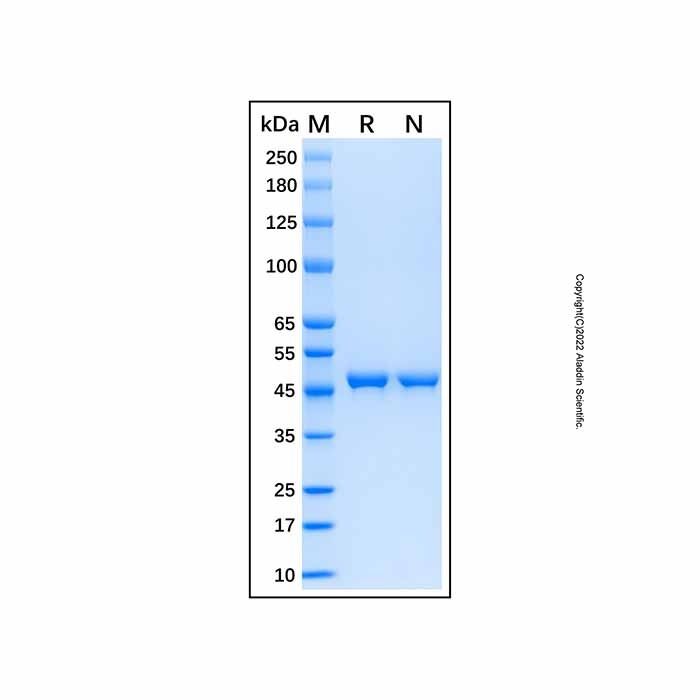
Recombinant Human ODC1 Protein (rp188261) - SDS-PAGE 2 μg/lane of Recombinant Human ODC1 Protein was resolved with SDS-PAGE under reducing (R) and non-reducing (N) conditions and visualized by Coomassie® Blue staining, showing a band at 47.4 kDa.

 ZJ24F1215952


 危险品化学品经营许可证(带存储)