Bromodomain-containing protein 4 (BRD4) is a member of the BET class chromatin reader proteins that bind acetylated histones and play a key role in transcriptional regulation and transmission of epigenetic memory. BRD4 has two N-terminal bromodomains and one NET (N-terminal Extra Terminal) domain. BRD bromodomains serve as recognition motifs for acetylated lysine residues on histones, while the NET domain may function by promoting phosphorylation of the C-terminal domain (CTD) of RNA Polymerase II. BRD4 is a potential therapeutic target in many diseases including breast cancer, AML, multiple myeloma, colon cancer and others. This recombinant protein contains an N-terminal portion of BRD4 including both bromodomains. This protein is useful as a substrate in in vitro assays using recombinant E3 Ubiquitin ligases and small molecule degraders.
Post-translational: Phosphorylation by CK2 disrupt the intramolecular binding between the bromo domain 2 and the NPS region and promotes binding between the NPS and the BID regions, leading to activate the protein and promote binding to acetylated histones. In absence of phosphorylation, BRD4 does not localize to p53/TP53 target gene promoters, phosphorylation promoting recruitment to p53/TP53 target promoters.
生物活性
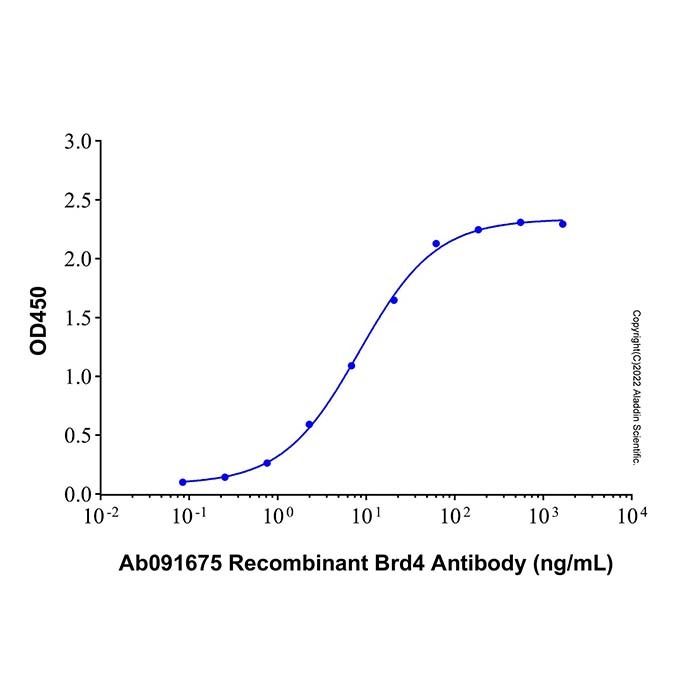
Immobilized Recombinant Human Brd4 Protein (rp188282) at 1.0 μg/mL can bind Recombinant Brd4 Antibody (Ab091675) with the EC50 of 8.4 ng/mL.
Store at -20°C for 1 year. Avoid freeze/thaw cycle.
图片
Recombinant Human Brd4 Protein (rp188282) - ELISA Immobilized Recombinant Human Brd4 Protein (rp188282) at 1.0 μg/mL can bind Recombinant Brd4 Antibody (Ab091675) with the EC₅₀ of 8.4 ng/mL.
Recombinant Human Brd4 Protein (rp188282) - SDS-PAGE 3 μg/lane of Recombinant Human Brd4 Protein was resolved with SDS-PAGE under reducing (R) and non-reducing (N) conditions and visualized by Coomassie® Blue staining, showing a band at 52.8 kDa.

 ZJ24F1215930


 危险品化学品经营许可证(带存储)