The protein encoded by this gene is a member of the transmembrane 4 superfamily, also known as the tetraspanin family. Most of these members are cell-surface proteins that are characterized by the presence of four hydrophobic domains. The proteins mediate signal transduction events that play a role in the regulation of cell development, activation, growth and motility. This encoded protein is a cell surface glycoprotein that is known to complex with integrins and other transmembrane 4 superfamily proteins. It is involved in cellular processes including cell adhesion and may regulate integrin trafficking and/or function. This protein enhances cell motility, invasion and metastasis of cancer cells. Multiple alternatively spliced transcript variants that encode the same protein have been described for this gene.
Post-translational: Palmitoylated. Palmitoylation by ZDHHC2 regulates CD151 expression, association with other tetraspanin family proteins and function in cell adhesion. Ubiquitinated by RNF128 on lysine residues present in the tetraspanin amino terminus via 'Lys-48'-linked ubiquitin leading to proteasomal degradation.
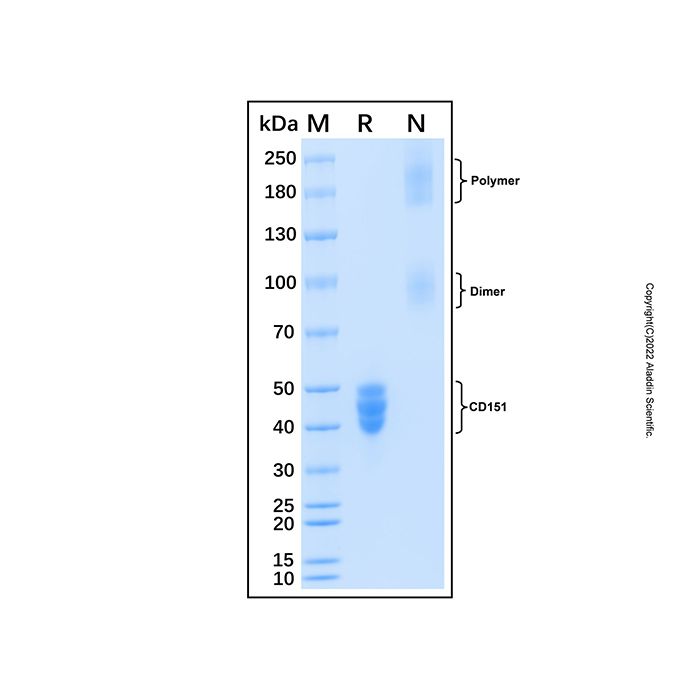
38.8-50.6 kDa, under reducing conditions; 86.6-106.5 & 168-235.9 kDa, under non-reducing conditions.
分子类型
蛋白质
产品线
生物产品
储存与运输
物理形态
冻干(Lyophilized)
储存缓冲液
Lyophilized from PBS, pH 7.4.
浓度
见COA
复溶
We recommend that this vial be briefly centrifuged prior to opening to bring the contents to the bottom. Reconstitute at 1.0 mg/mL in sterile distilled water. Stock solutions should be apportioned into working aliquots and stored at ≤ -20 °C. Further dilutions should be made in appropriate buffered solutions.
储存条件
-20°C储存,避免反复冻融
运输条件
超低温运输
稳定性与储存
Store at -20℃ for 12 months. Upon reconstitution, it is recommended to aliquot. Avoid freeze/thaw cycle.
图片
Recombinant Human CD151 Protein (rp188287) - SDS-PAGE
3 μg/lane of Recombinant Human CD151 Protein was resolved with SDS-PAGE under reducing (R) and non-reducing (N) conditions and visualized by Coomassie® Blue staining, showing the bands at 38.8-50.6 kDa under reducing conditions and 86.6-106.5 & 168-235.9 kDa under non-reducing conditions.
The observation of protein as both dimers and polymers under non-reducing (NR) conditions suggests that a portion of the protein forms dimers and polymers. This dimerization may be mediated by (or stabilized by) disulfide bonds (Uniprot: P48509).

 ZJ25F1029184


 危险品化学品经营许可证(带存储)