无动物源,无载体,生物活性,ActiBioPure™,Fc标签,≥95%(SDS-PAGE),expressed in HEK293; 见COA
生化机理
Contactin-6, also known as NB-3, is a 130 kDa member of the TAG/F3 subgroup of Contactin GPI‑linked neuronal adhesion proteins. Mature human Contactin-6 consists of six immunoglobulin‑like domains (aa 26‑587), a flexible linker region, four fibronectin type III domains (aa 597‑992), and a GPI anchor. Within aa 20‑891, human Contactin-6 shares 89% aa sequence identity with mouse and rat Contactin-6. Contactin-6 expression is upregulated postnatally in the cerebellum, brainstem, and hippocampus, and it shows differential expression within various structures of the brain. In the cerebellum, it is presynaptically localized at synapses between excitatory glutamatergic parallel fibers and Purkinje cells. Contactin-6 associates in cis with CHL-1, PTPR alpha, and PTPR gamma as well as in trans with Notch-1 on oligodendrocytes. Its binding to Notch-1 triggers the release and translocation of the Notch intracellular domain to the nucleus and promotes oligodendrogenesis. Contactin-6 function is important in the postnatal development and function of the cerebellum, as shown in knockout mice which exhibit poor motor coordination.
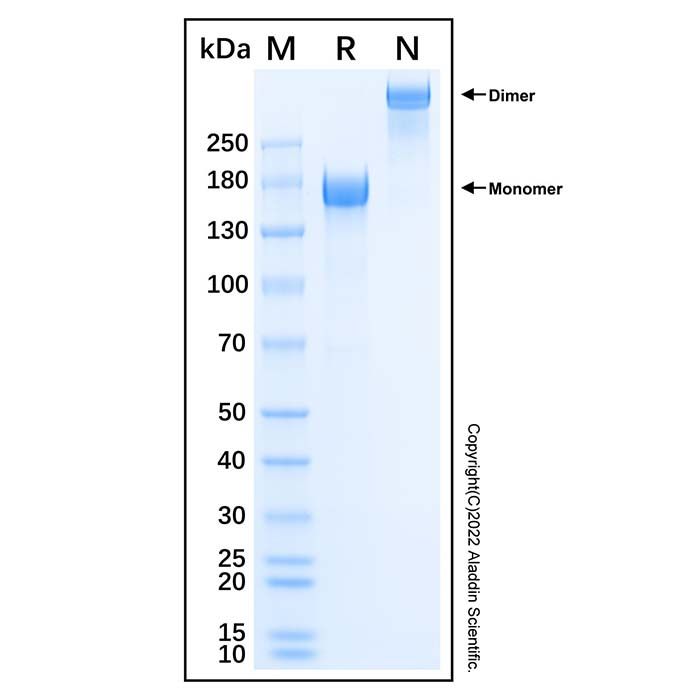
153.3-188.0 kDa, under reducing conditions; >250 kDa, under non-reducing conditions.
分子类型
蛋白质
产品线
生物产品
储存与运输
物理形态
冻干(Lyophilized)
储存缓冲液
Lyophilized from PBS, pH 7.4
浓度
expressed in HEK293; 见COA
复溶
We recommend that this vial be briefly centrifuged prior to opening to bring the contents to the bottom. Reconstitute at 1.0 mg/mL in sterile distilled water. Stock solutions should be apportioned into working aliquots and stored at ≤ -20 °C. Further dilutions should be made in appropriate buffered solutions.
储存条件
-20°C储存,避免反复冻融
运输条件
超低温运输
稳定性与储存
-20℃保存 12个月;复溶后建议分装,避免反复冻融。
图片
Recombinant Human Contactin-6 Protein (rp188296) - SDS-PAGE
3 μg/lane of Recombinant Human Contactin-6 Protein was resolved with SDS-PAGE under reducing (R) and non-reducing (N) conditions and visualized by Coomassie® Blue staining, showing a band at 153.3 -188.0 kDa under reducing conditions and >250 kDa under non-reducing conditions.
Fc fusion proteins can be linked by disulfide bonds in the Fc hinge region to form stable dimers(PMID: 23665380).



 危险品化学品经营许可证(带存储)