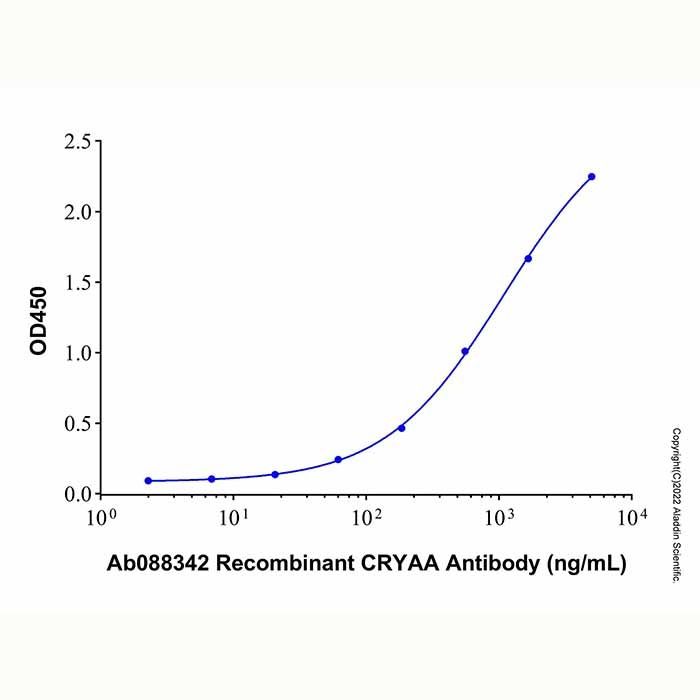
Immobilized Recombinant Human Alpha A Crystallin/CRYAA Protein (rp188357) at 1.0 μg/mL can bind Recombinant CRYAA Antibody (Ab088342) with the EC50 of 1.08 μg/mL.
Recombinant Human Alpha A Crystallin/CRYAA Protein
别名
重组人Alpha A Crystallin/CRYAA蛋白 | 重组人α-晶状体蛋白A链蛋白 | 重组人晶状体蛋白ΑA
英文别名
Acry 1 | Alpha crystallin A chain | Alpha-crystallin A chain | CRYA 1 | CRYA1 | CRYAA | CRYAA_HUMAN | Crystallin alpha 1 | Crystallin alpha A | Heat shock protein beta 4 | Heat shock protein beta-4 | HSPB 4 | HspB4 | short form | Zonular Central Nuclear C
规格或纯度
无载体,生物活性,ActiBioPure™,His标签,≥90%(SDS-PAGE)
生化机理
Contributes to the transparency and refractive index of the lens. In its oxidized form (absence of intramolecular disulfide bond), acts as a chaperone, preventing aggregation of various proteins under a wide range of stress conditions. Required for the correct formation of lens intermediate filaments as part of a complex composed of BFSP1, BFSP2 and CRYAA.
Post-translational: O-glycosylated; contains N-acetylglucosamine side chains. Deamidation of Asn-101 in lens occurs mostly during the first 30 years of age, followed by a small additional amount of deamidation (approximately 5%) during the next approximately 38 years, resulting in a maximum of approximately 50% deamidation during the lifetime of the individual. Phosphorylation on Ser-122 seems to be developmentally regulated. Absent in the first months of life, it appears during the first 12 years of human lifetime. The relative amount of phosphorylated form versus unphosphorylated form does not change over the lifetime of the individual. Acetylation at Lys-70 may increase chaperone activity. Undergoes age-dependent proteolytical cleavage at the C-terminus. Alpha-crystallin A(1-172) is the most predominant form produced most rapidly during the first 12 years of age and after this age is present in approximately 50% of the lens molecules. In young individuals and during the first approximately 30 years of life, less than half molecules contain an intramolecular disulfide bond (oxidized form), while in the remaining fraction the cysteines are in the free sulfhydryl form (reduced form). With aging, the amount of oxidized form increases up to 90% and it becomes a major constituent of high molecular weight aggregates, concomitant with an age-dependent loss of its chaperone activity. The reduced form is undetectable in cataractous lenses.
生物活性
Immobilized Recombinant Human Alpha A Crystallin/CRYAA Protein (rp188357) at 1.0 μg/mL can bind Recombinant CRYAA Antibody (Ab088342) with the EC50 of 1.08 μg/mL.
19.8 kDa, under reducing conditions; 20.2 kDa, under non-reducing conditions
分子类型
蛋白质
产品线
生物产品
储存与运输
物理形态
冻干(Lyophilized)
储存缓冲液
Lyophilized from PBS, 2mM EDTA, pH 8.0.
复溶
We recommend that this vial be briefly centrifuged prior to opening to bring the contents to the bottom. Reconstitute at 1.0 mg/mL in sterile distilled water. Stock solutions should be apportioned into working aliquots and stored at ≤ -20 °C. Further dilutions should be made in appropriate buffered solutions.
储存条件
-20°C储存,避免反复冻融
运输条件
超低温运输
稳定性与储存
Store at -20°C for 1 year. Avoid freeze/thaw cycle.
图片
Recombinant Human Alpha A Crystallin/CRYAA Protein (rp188357) - ELISA Immobilized Recombinant Human Alpha A Crystallin/CRYAA Protein (rp188357) at 1.0 μg/mL can bind Recombinant CRYAA Antibody (Ab088342) with the EC50 of 1.08 μg/mL.
Recombinant Human Alpha A Crystallin/CRYAA Protein (rp188357) - SDS-PAGE 3 μg/lane of Recombinant Human Alpha A Crystallin/CRYAA Protein was resolved with SDS-PAGE under reducing (R) and non-reducing (N) conditions and visualized by Coomassie® Blue staining, showing a band at 19.8 kDa under reducing conditions and 20.2 kDa under non-reducing conditions.

 ZJ25F0218471


 危险品化学品经营许可证(带存储)