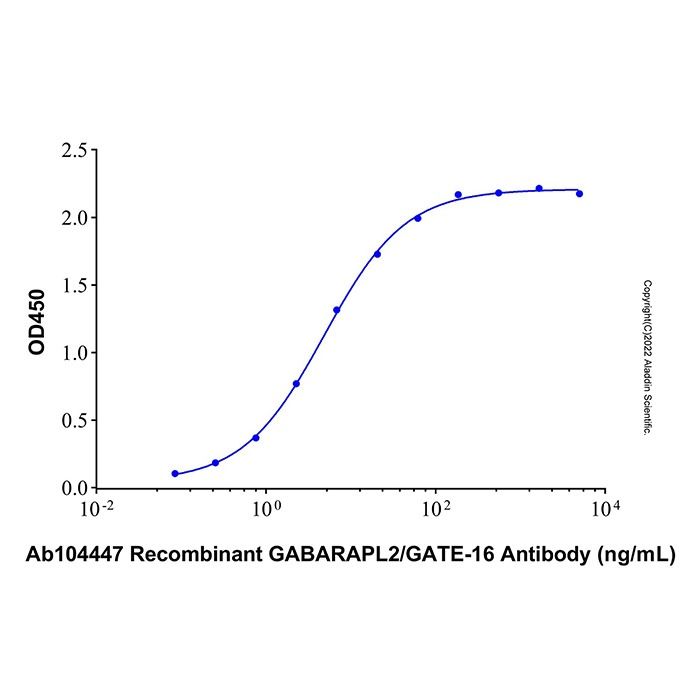
Immobilized Recombinant Human GABARAPL2/GATE-16 Protein (rp188391) at 1.0 μg/mL can bind Recombinant GABARAPL2/GATE-16 Antibody (Ab104447) with the EC50 of 4.9 ng/mL.
无载体,生物活性,ActiBioPure™,His标签,PBS Only,≥95%(SDS-PAGE),See COA
生化机理
GATE-16, also known as ATG8, belongs to the MAP1 LC3 family. It is expressed at high levels in the brain, heart, prostate, ovary, spleen and skeletal muscle. GATE-16 is expressed at very low levels in lung, thymus and small intestine. GATE-16 is involved in intra-Golgi traffic. It modulates intra-Golgi transport through coupling between NSF activity and SNAREs activation. It first stimulates the ATPase activity of NSF which in turn stimulates the association with GOSR1.
Post-translational: The precursor molecule is cleaved by ATG4 (ATG4A, ATG4B, ATG4C or ATG4D) to expose the glycine at the C-terminus and form the cytosolic form, GABARAPL2-I(PubMed:15169837, PubMed:20818167, PubMed:30661429, PubMed:31709703).
The processed form is then activated by APG7L/ATG7, transferred to ATG3 and conjugated to phosphatidylethanolamine (PE) phospholipid to form the membrane-bound form, GABARAPL2-II (PubMed:15169837, PubMed:31709703). During non-canonical autophagy, the processed form is conjugated to phosphatidylserine (PS) phospholipid (PubMed:33909989). ATG4 proteins also mediate the delipidation of PE-conjugated forms required for GABARAPL2 recycling when autophagosomes fuse with lysosomes (PubMed:29458288, PubMed:31709703, PubMed:33909989). In addition, ATG4B and ATG4D mediate delipidation of ATG8 proteins conjugated to PS during non-canonical autophagy (PubMed:33909989). ATG4B constitutes the major protein for proteolytic activation (PubMed:30661429). ATG4D is the main enzyme for delipidation activity (By similarity). (Microbial infection) The Legionella effector RavZ is a deconjugating enzyme that hydrolyzes the amide bond between the C-terminal glycine residue and an adjacent aromatic residue in ATG8 proteins conjugated to phosphatidylethanolamine (PE), producing an ATG8 protein that is resistant to reconjugation by the host machinery due to the cleavage of the reactive C-terminal glycine. RavZ is also able to mediate delipidation of ATG8 proteins conjugated to phosphatidylserine (PS) (PubMed:33909989). Phosphorylation at Ser-87 and Ser-88 by TBK1 prevents interaction with ATG4 (ATG4A, ATG4B, ATG4C or ATG4D) (PubMed:31709703). Phosphorylation by TBK1 on autophagosomes prevents their delipidation by ATG4 and premature removal from nascent autophagosomes (PubMed:31709703).
生物活性
Immobilized Recombinant Human GABARAPL2/GATE-16 Protein (rp188391) at 1.0 μg/mL can bind Recombinant GABARAPL2/GATE-16 Antibody (Ab104447) with the EC50 of 4.9 ng/mL.
15.1 kDa, under reducing conditions; 15.2 & 29.1 kDa, under non-reducing conditions.
分子类型
蛋白质
产品线
生物产品
储存与运输
物理形态
冻干(Lyophilized)
储存缓冲液
Lyophilized from PBS, pH 7.4.
浓度
See COA
复溶
e recommend that this vial be briefly centrifuged prior to opening to bring the contents to the bottom. Reconstitute at 1.0 mg/mL in sterile distilled water. Stock solutions should be apportioned into working aliquots and stored at ≤ -20 °C. Further dilutions should be made in appropriate buffered solutions.
储存条件
-20°C储存,避免反复冻融
运输条件
超低温运输
稳定性与储存
Store at -20°C for 1 year. Avoid freeze/thaw cycle. Upon reconstitution, it is recommended to aliquot.
图片
Recombinant Human GABARAPL2/GATE-16 Protein (rp188391) - ELISA Immobilized Recombinant Human GABARAPL2/GATE-16 Protein (rp188391) at 1.0 μg/mL can bind Recombinant GABARAPL2/GATE-16 Antibody (Ab104447) with the EC50 of 4.9 ng/mL.
Recombinant Human GABARAPL2/GATE-16 Protein (rp188391) - SDS-PAGE 3 μg/lane of Recombinant Human GABARAPL2/GATE-16 Protein was resolved with SDS-PAGE under reducing (R) and non-reducing (N) conditions and visualized by Coomassie® Blue staining, showing a band at 15.1 kDa under reducing conditions and 15.2 & 29.1 kDa under non-reducing conditions. GABARAP, composing of Ile21, Pro30, Tyr49, Leu50, Val 51, Lue55,Phe60, Leu63, and Phe-104, might be involved in dimerization or oligomerization, interaction with the c2 subunit, and/or N-ethylamaleimide-sensitive factor (NSF) (PMID: 17083446).

 ZJ25F0521546


 危险品化学品经营许可证(带存储)