级别和纯度: 无载体?无载体(Carrier Free)—— 不含添加的载体蛋白/稳定剂。当载体(如 BSA)会干扰偶联或敏感检测时使用。His标签?组氨酸(His) 标签级 —— 带有 His 标签的重组蛋白,供亲和纯化/检测。用于纯化、固定或检测带标签蛋白。≥95%(SDS-PAGE)expressed in E. coli; 见COA
无载体, His标签, ≥95%(SDS-PAGE), expressed in E. coli; 见COA
生化机理
Lysosomal thiol reductase that catalyzes protein disulfide bonds reduction (PubMed:10639150).
Plays an important role in antigen processing and presentation, of namely both major histocompatibility complex (MHC) class I- and class II-restricted antigen by reducing the disulfide bonds of endocytosed proteins and facilitating their unfolding and optimal degradation (PubMed:10639150).
Shares with thioredoxin a reduction mechanism in which the N-terminal cysteine thiol group in the CXXC active site motif initiates a nucleophilic attack on the substrate disulfide bond,resulting in the formation of a mixed disulfide-linked enzyme-substrate intermediate (Probable). Subsequent intramolecular attack by the second cysteine thiol group enables the release of the reduced substrate and oxidized enzyme (Probable). Lysosomal cysteine is a physiological reducing agent that is capable of reducing IFI30, so that it can catalyzes the next reaction (PubMed:10852914).
Dithiothreitol, cysteine, and cysteinyl glycine, but not glutathione, are capable of regenerating active precursor and mature IFI30 in vitro (PubMed:10639150, PubMed:10852914).
Post-translational: N-glycosylated. Sugar chains contain mannose-6-phosphate. Synthesized as a 35 kDa precursor which is then processed into the mature 30 kDa form via cleavage of N-terminal and C-terminal propeptides. Processing of the precursor is mediated by multiple lysosomal proteases.
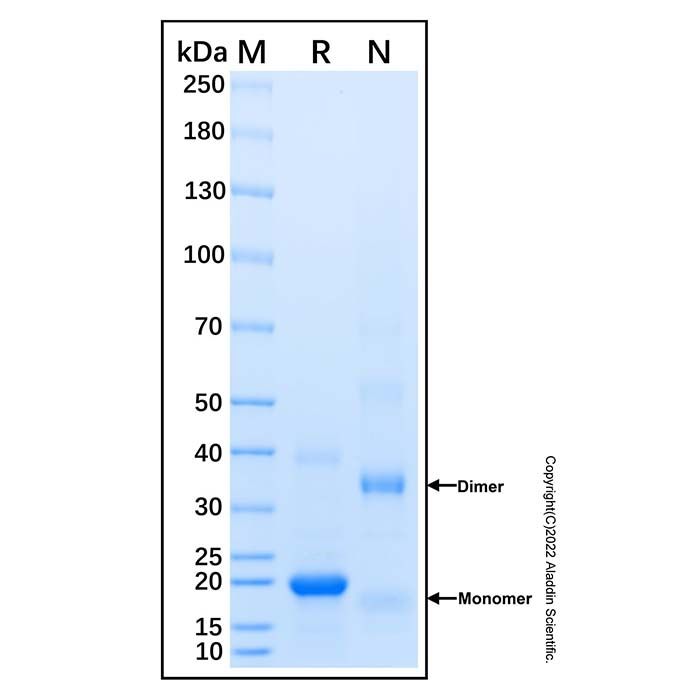
Recombinant Human GILT Protein (rp188407) - SDS-PAGE
3 μg/lane of Recombinant Human GILT Protein was resolved with SDS-PAGE under reducing (R) and non-reducing (N) conditions and visualized by Coomassie® Blue staining, showing the bands at 19.7 & 38.7 kDa under reducing conditions and 17.7 & 33.6 kDa under non-reducing conditions.
The GILT protein can exist in a dimeric form connected by disulfide bonds, and this phenomenon is mainly observed in the proteins secreted outside the cell (PMID: 3136170).

 ZJ26F0939095


 危险品化学品经营许可证(带存储)