Recombinant Human CD302/CLEC13A Fc Chimera Protein
别名
重组人CD302/CLEC13A蛋白 | 重组人CD302抗原蛋白
英文别名
BIMLEC | CD302 antigenC-type lectin domain family 13, member A | CD302 molecule | CD302 | CLEC13A | CLEC13AMGC22301 | C-type lectin domain family 13 member A | DCL1 | DCL-1 | DCL1C-type lectin BIMLEC | KIAA0022FLJ43091 | Type I transmembrane C-type lectin
规格或纯度
无动物源,无载体,Fc标签,PBS Only,≥95%(SDS-PAGE),见COA
生化机理
CD302, also known as CLEC13A and DCL1, is a type I transmembrane C-type lectin receptor. It was identified while cloning human DEC-205 and was termed DCL1 (DEC-205-associated C-type lectin-1). In humans, the highest expression of CD302 transcripts was observed in the liver, followed by lungs, spleen, and myeloid PBMC populations including monocytes, granulocytes, and dendritic cells (DC). Human CD302 is synthesized as a 232 amino acid (aa) protein that includes a 22 aa signal peptide, a 146 aa extracellular domain (ECD), a 21 aa transmembrane segment, and a 43 aa cytoplasmic region. The extracellular domain is predicted to contain eight beta strands and two ɑ helices using NMR. Within the ECD, human CD302 shares 82% aa sequence identity with mouse and rat CD302. Unlike other classical C-type lectin receptors, CD302 is missing the known amino acid residues essential for calcium-dependent sugar binding, suggesting that CD302 may not have classic sugar binding capacity. However, CD302 did have the ability to behave as an endocytosis/phagocytosis receptor. In addition, CD302 was shown to colocalize with F-actin rich migratory structures, including filopodia, lamellipodia, and podosomes in macrophages, where CD302 may bind yet to be determined endothelial ligands involved in DC adhesion or migration. Further evidence that CD302 is involved in regulating DC migration includes that CD302 knockout mice had reduced frequency and numbers of migratory DC within the lymph nodes (LN) and reduced in vivo capacity to reach draining LN. CD302 was also found to exist as an intergenic splice variant able to form a fusion protein with DEC-205/CD205 in Hodgkin's lymphoma cell lines. The CD302/DEC-205 fusion protein was also found to be expressed by mature dendritic cells which altered endocytic capacity of DEC-205, although the wild-type single gene transcripts were the dominant isoforms expressed. Due to its selective expression in myeloid immune populations, CD302 has become a potential therapeutic target for acute myeloid leukemia (AML).
Post-translational: May be heterogeneously N-glycosylated in some cell types.
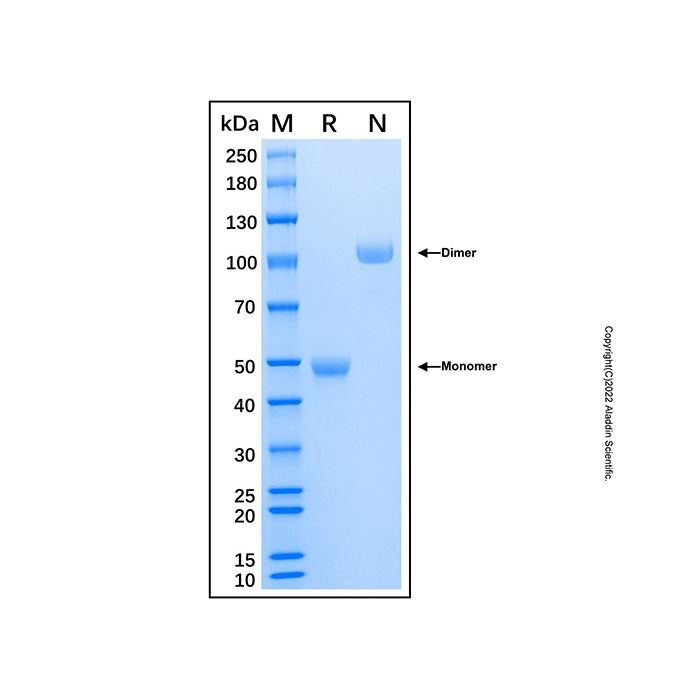
45.5-52.0 kDa, under reducing conditions; 97.1-111.4 kDa, under non-reducing conditions.
分子类型
蛋白质
产品线
生物产品
储存与运输
物理形态
冻干(Lyophilized)
储存缓冲液
Lyophilized from PBS, pH 7.4
浓度
见COA
复溶
We recommend that this vial be briefly centrifuged prior to opening to bring the contents to the bottom. Reconstitute at 1.0 mg/mL in sterile distilled water. Stock solutions should be apportioned into working aliquots and stored at ≤ -20 °C. Further dilutions should be made in appropriate buffered solutions.
储存条件
-20°C储存,避免反复冻融
运输条件
超低温运输
稳定性与储存
Store at -20°C for 1 year. Avoid freeze/thaw cycle.
图片
Recombinant Human CD302/CLEC13A Fc Chimera Protein (rp188440) - SDS-PAGE 3 μg/lane of Recombinant Human CD302/CLEC13A Fc Chimera Protein was resolved with SDS-PAGE under reducing (R) and non-reducing (N) conditions and visualized by Coomassie® Blue staining, showing a band at 45.5-52.0 kDa under reducing conditions and 97.1-111.4 kDa under non-reducing conditions. Fc fusion proteins can be linked by disulfide bonds in the Fc hinge region to form stable dimers (PMID: 23665380).

 ZJ25F0521543


 危险品化学品经营许可证(带存储)