Carcinoembryonic Antigen-related Cell Adhesion Molecule 18 (CEACAM-18) is part of the CEA protein family consisting of CEACAMs and the pregnancy-specific glycoproteins (PSGs). Both CEACAM and PSG molecules have been identified in humans and belong to the much larger glycosylphosphatidylinositol (GPI)-linked immunoglobulin (Ig) superfamily. Mature human CEACAM-18 has a 298 amino acid (aa) extracellular domain containing 2 IgC2-like and 1 IgV-like domains, a single transmembrane domain and a short cytoplasmic tail. CEACAM-18 is one of only five conserved CEACAMs among mouse, rat, and human, but mature human CEACAM-18 has low aa sequence identify with mouse and rat at 60% and 58%, respectively. Originally discovered as a biomarker for colorectal cancer, CEACAMs have now been associated with numerous intracellular signaling processes including cell adhesion, cell growth, recognition and differentiation, angiogenesis, and apoptosis. While the exact function of CEACAM-18 has been yet to be elucidated, it may bind pathogen receptors or other immunoregulatory members. CEACAM family members were identified as the major Galectin-3 receptor candidates on human neutrophils. Binding of carbohydrate ligands to CEACAMs may be important in the release of proinflammatory mediators.
We recommend that this vial be briefly centrifuged prior to opening to bring the contents to the bottom. Reconstitute at 1.0 mg/mL in sterile distilled water. Stock solutions should be apportioned into working aliquots and stored at ≤ -20 °C. Further dilutions should be made in appropriate buffered solutions.
储存条件
-20°C储存,避免反复冻融
运输条件
超低温运输
稳定性与储存
-20℃保存12个月;复溶后建议分装,避免反复冻融。
图片
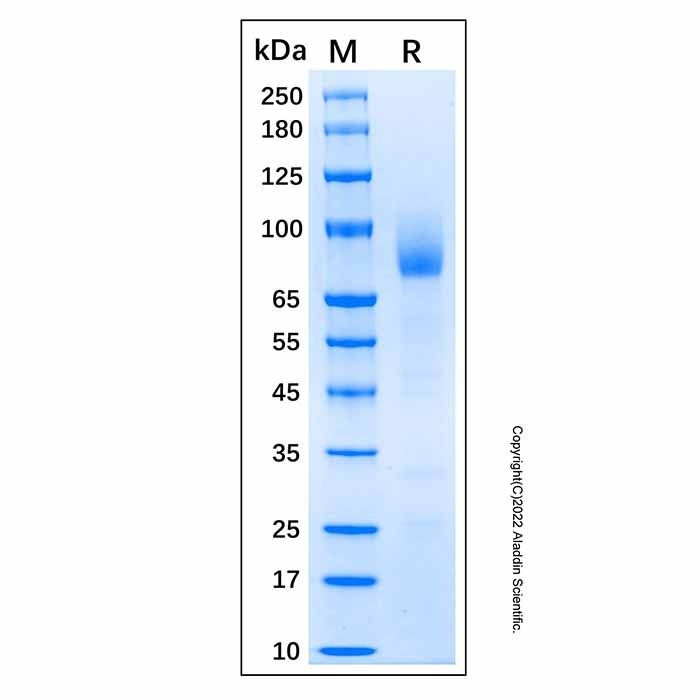
Recombinant Human CEACAM-18 Protein (rp188442) - SDS-PAGE 3 μg/lane of Recombinant Human CEACAM-18 Protein was resolved with SDS-PAGE under reducing (R) conditions and visualized by Coomassie® Blue staining, showing a band at 73.8-108.5 kDa.

 ZJ25F0622475


 危险品化学品经营许可证(带存储)