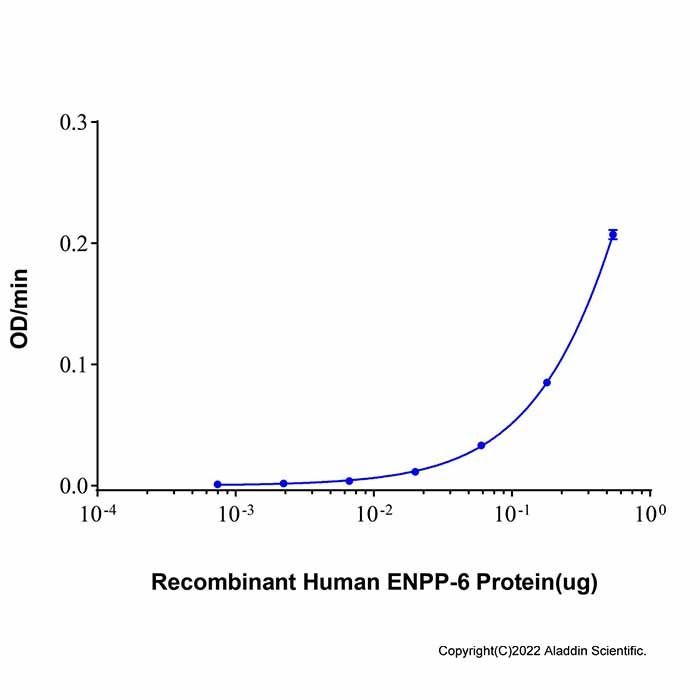
Measured by its ability to cleave O-(4-Nitrophenylphosphoryl) choline. The specific activity is >4,000 pmol/min/μg, as measured under the described conditions.
Ectonucleotide Pyrophosphatase/Phosphodiesterase 6 (ENPP-6) is a choline-specific glycerophosphodiester phosphodiesterase. It is a member of a family of membrane-linked glycoproteins that, at an alkaline pH, hydrolyze pyrophosphate or phosphodiester bonds in a variety of extracellular compounds including nucleotides, lysophospholipids, and choline phosphate esters. ENPP-6 is a GPI-linked protein that is synthesized as a 440 amino acid (aa) precursor and has a predicted molecular weight of approximately 55 kDa. Its extracellular region contains a catalytic domain that is nearly 400 aa in length and shares 88% aa sequence identity with the mouse and rat orthologs. A soluble form of ENPP-6 can be proteolytically shed and associate into a disulfide-linked homodimer.The catalytic domain of ENPP-6 specifically recognizes the phosphocholine part of its substrate. ENPP-6 has been shown to display preference for choline-containing phospholipids or phosphodiesters such as lysophosphatidylcholine (LPC), glycerophosphorylcholine (GPC), sphingosylphosphorylcholine (SPC), Platelet-Activating Factor (PAF), and lysoPAF. Furthermore, ENPP-6 shows preference for LPC with short (12:0 and 14:0) or polyunsaturated (18:2 and 20:4) fatty acids. In vitro, ENNP-6 has been shown to efficiently hydrolyze the classical substrate for phospholipase C, p-nitrophenyl phosphorylcholine, but not the classical nucleotide phosphodiesterase substrate, p-nitrophenyl thymidine 5'-monophosphate. ENPP-6 is predominantly expressed in brain, where it is localized to myelin and kidney, with lesser expression being found in the heart. ENPP-6 expression in the brain has been shown to be regulated by Thyroid Hormone and iron. Additionally, in rat brain, ENPP-6 expression has been shown to be up-regulated during oligodendrocyte differentiation.
生物活性
Measured by its ability to cleave O-(4-Nitrophenylphosphoryl) choline. The specific activity is >4,000 pmol/min/μg, as measured under the described conditions.
52.2 kDa, under reducing conditions; 51.6 & 105.0 kDa, under non-reducing conditions.
分子类型
蛋白质
产品线
生物产品
储存与运输
物理形态
冻干(Lyophilized)
储存缓冲液
20 mM Tris, 150 mM NaCl, pH 8.8.
浓度
见COA
复溶
We recommend that this vial be briefly centrifuged prior to opening to bring the contents to the bottom. Reconstitute at 0.5 mg/mL in sterile distilled water. Stock solutions should be apportioned into working aliquots and stored at ≤ -20 °C. Further dilutions should be made in appropriate buffered solutions.
储存条件
-20°C储存,避免反复冻融
运输条件
超低温运输
稳定性与储存
Store at -20°C for 1 year. Avoid freeze/thaw cycle.
图片
Recombinant Human ENPP-6 Protein (rp188461) - Enzyme Activity Measured by its ability to cleave O-(4-Nitrophenylphosphoryl) choline. The specific activity is >4,000 pmol/min/μg, as measured under the described conditions. Materials: Assay Buffer: 50 mM Tris, 0.5 M NaCl, pH 9.0 Recombinant Human ENPP-6 Protein (rp188461) Substrate: O-(4-Nitrophenylphosphoryl) choline (N131172), 500 mM stock in deionized water Procedures: 1. Dilute rhENPP-6 to 0.4 µg/mL in Assay buffer. 2. Dilute room temperature Substrate to 2 mM in Assay buffer. 3. Load 50 µL of 0.4 ng/µL rhENPP-6 in a clear strip well plate. 4. Start the reaction by adding 50 µL of 2 mM Substrate. Include a Substrate Blank containing 50 µL Assay Buffer and 50 µL Substrate. 5. Read at 405 nm (absorbance) in kinetic mode for 5 minutes. 6. Calculate specific activity:
*Adjusted for Substrate Blank. **Derived using calibration standard p-Nitrophenol (Sigma, Catalog # 241326). Per Well: rhP4HB: 0.0015 mg, Insulin: 0.100 mg.
Recombinant Human ENPP-6 Protein (rp188461) - SDS-PAGE 3 μg/lane of Recombinant Human ENPP-6 Protein was resolved with SDS-PAGE under reducing (R) and non-reducing (N) conditions and visualized by Coomassie® Blue staining, showing a band at 52.2 kDa under reducing conditions and 51.6 & 105.0 kDa under non-reducing conditions. ENPP6 all of the N-glycans were endo H-sensitive, in liver and kidney only one of the glycosylation sites was occupied by an endo H-sensitive glycan, likely N406, which is located within the cleft formed by the dimer interface (PMID: 25142936).

 ZJ25F0825648


 危险品化学品经营许可证(带存储)