Apoptosis regulator protein which may function as a crucial link between cell survival and cell death pathways in mammalian cells. Acts as an inhibitor of TNFRSF6 mediated apoptosis. A proteolytic fragment (p43) is likely retained in the death-inducing signaling complex (DISC) thereby blocking further recruitment and processing of caspase-8 at the complex. Full length and shorter isoforms have been shown either to induce apoptosis or to reduce TNFRSF-triggered apoptosis. Lacks enzymatic (caspase) activity.
Post-translational: Proteolytically processed by CASP8 generating subunit p43 and p12.
We recommend that this vial be briefly centrifuged prior to opening to bring the contents to the bottom. Reconstitute at 1.0 mg/mL in sterile distilled water. Stock solutions should be apportioned into working aliquots and stored at ≤ -20 °C. Further dilutions should be made in appropriate buffered solutions.
储存条件
-20°C储存,避免反复冻融
运输条件
超低温运输
稳定性与储存
Store at -20℃ for 12 months. Upon reconstitution, it is recommended to aliquot. Avoid freeze/thaw cycle.
图片
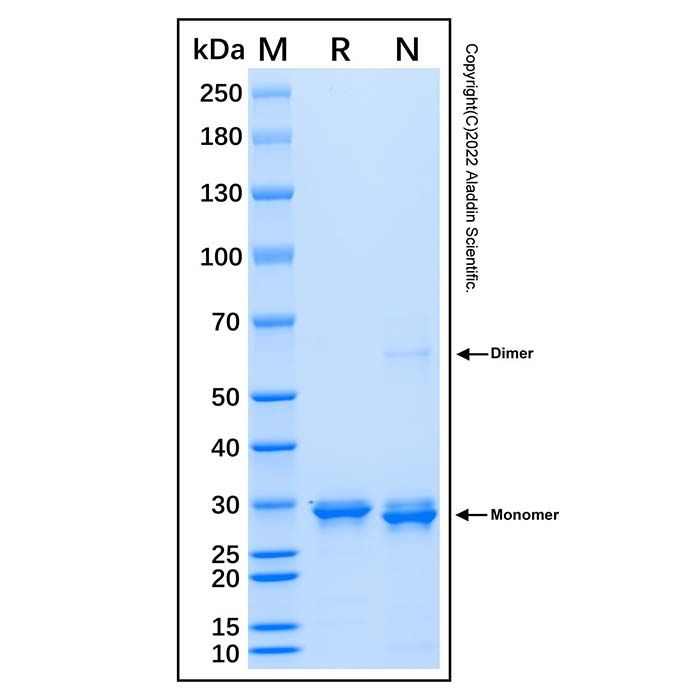
Recombinant Human CFLAR Protein (rp189315) - SDS-PAGE 3 μg/lane of Recombinant Human CFLAR Protein was resolved with SDS-PAGE under reducing (R) and non-reducing (N) conditions and visualized by Coomassie® Blue staining, showing a band at 29.2 kDa under reducing conditions and 29.2 & 60.7 kDa under non-reducing conditions. The observation of CFLAR Protein as both dimers and monomers under non-reducing (NR) conditions suggests that a portion of the protein forms dimers. This dimerization may be mediated by (or stabilized by) disulfide bonds (Uniprot: O15519).

 ZJ25F0724459


 危险品化学品经营许可证(带存储)