Positively regulates a late step in exocytosis of various cytoplasmic vesicles, such as synaptic vesicles and other secretory vesicles (PubMed:21785414). Organizes the SNAREs into a cross-linked zigzag topology that, when interposed between the vesicle and plasma membranes, is incompatible with fusion, thereby preventing SNAREs from releasing neurotransmitters until an action potential arrives at the synapse (PubMed:21785414). Also involved in glucose-induced secretion of insulin by pancreatic beta-cells. Essential for motor behavior.
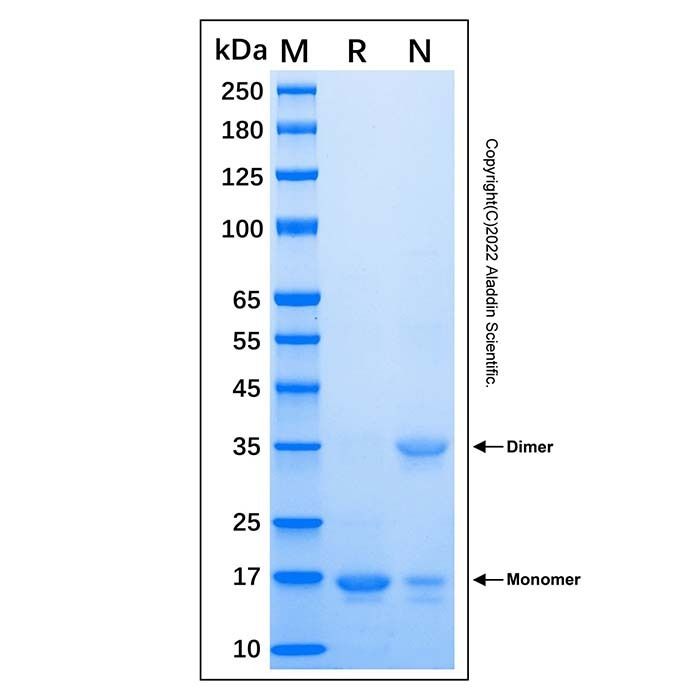
16.5 kDa, under reducing conditions; 16.5 & 34.4 kDa, under non-reducing conditions.
分子类型
蛋白质
产品线
生物产品
储存与运输
物理形态
液体
储存缓冲液
20mM Tris, 150mM NaCl, 10% Glycerol, pH 8.0
浓度
见COA
储存条件
-20°C储存,避免反复冻融
运输条件
超低温运输
稳定性与储存
Store at -20°C for 1 year. Avoid freeze/thaw cycle.
图片
Recombinant Human CPLX1 Protein (rp189332) - SDS-PAGE 3 μg/lane of Recombinant Human CPLX1 Protein was resolved with SDS-PAGE under reducing (R) and non-reducing (N) conditions and visualized by Coomassie® Blue staining, showing a band at 16.5 kDa under reducing conditions and 16.5 & 34.4 kDa under non-reducing conditions. Although there is no direct evidence suggesting that CPLX1 protein can form dimers, the function of CPLX1 protein described in UniProtKB, which organizes SNAREs into a 'cross-linked, saw-tooth topology', implies that CPLX1 protein may function as a multimer (Uniprot ID: O14810).

 ZJ25F0319668


 危险品化学品经营许可证(带存储)