Cullin1, also known CUL1, is a core component of multiple cullin-RING-based SCF (SKP1-CUL1-F-box protein) E3 ubiquitin-protein ligase complexes, which mediate the ubiquitination of proteins involved in cell cycle progression, signal transduction and transcription. In the SCF complex, it serves as a rigid scaffold that organizes the SKP1-F-box protein and RBX1 subunits. Cullin1 may contribute to catalysis through positioning of the substrate and the ubiquitin-conjugating enzyme. Recombinant human CUL1 protein, fused to His-tag at N-terminus, was expressed in E.coli and purified by using conventional chromatography techniques.
Post-translational: Neddylated; which enhances the ubiquitination activity of SCF (PubMed:24076655, PubMed:27565346, PubMed:15537541). Neddylation prevents binding of the inhibitor CAND1 (PubMed:15537541). Neddylation leads to structural rearrangment in the complex that allows interaction between the E2 ubiquitin-conjugating enzyme and the acceptor ubiquitin (PubMed:38326650). Deneddylated via its interaction with the COP9 signalosome (CSN) complex (PubMed:10597293, PubMed:10713156, PubMed:15537541, PubMed:18805092).(Microbial infection) Deneddylated by Epstein-Barr virus BPLF1 leading to a S-phase-like environment that is required for efficient replication of the viral genome (PubMed:20190741).
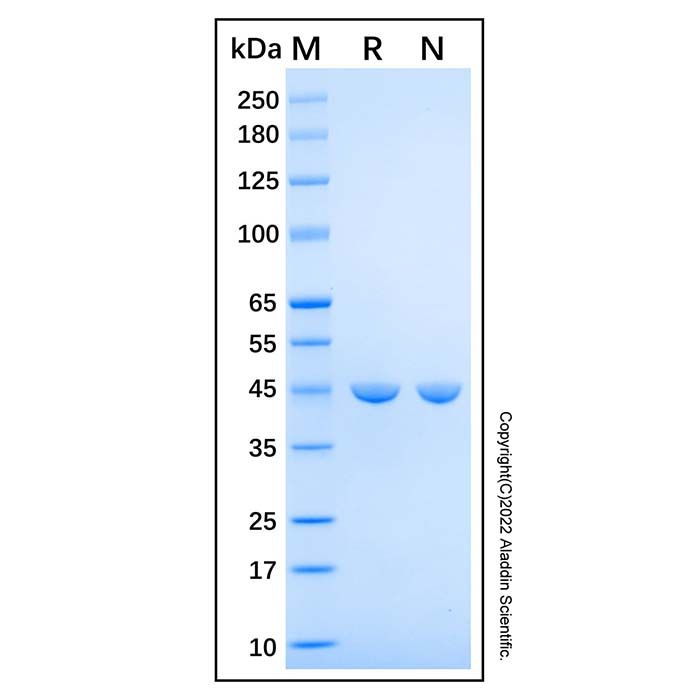
Recombinant Human CUL1 Protein (rp189358) - SDS-PAGE 3 μg/lane of Recombinant Human CUL1 Protein was resolved with SDS-PAGE under reducing (R) and non-reducing (N) conditions and visualized by Coomassie® Blue staining, showing a band at 44.1 kDa.



 危险品化学品经营许可证(带存储)