Dual specificity phosphatase 19, also known as DUSP19, is a member of the dual specificity protein phosphatase subfamily. DUSPs are characterized by their ability to dephosphorylate both tyrosine and serine/threonine residues. They have been implicated as major modulators of critical signaling pathways. DUSP19 is a protein phosphatase which functions as a stress-activated protein kinase pathway-regulating phosphatase. DUSP19 contains a variation of the consensus DUSP C-terminal catalytic domain, with the last serine residue replaced by alanine, and lacks the N-terminal CH2 domain found in the MKP class of DUSPs. Recombinant human DUSP19 protein, fused to His-tag at N-terminus, was expressed in E.coli and purified by using conventional chromatography techniques.
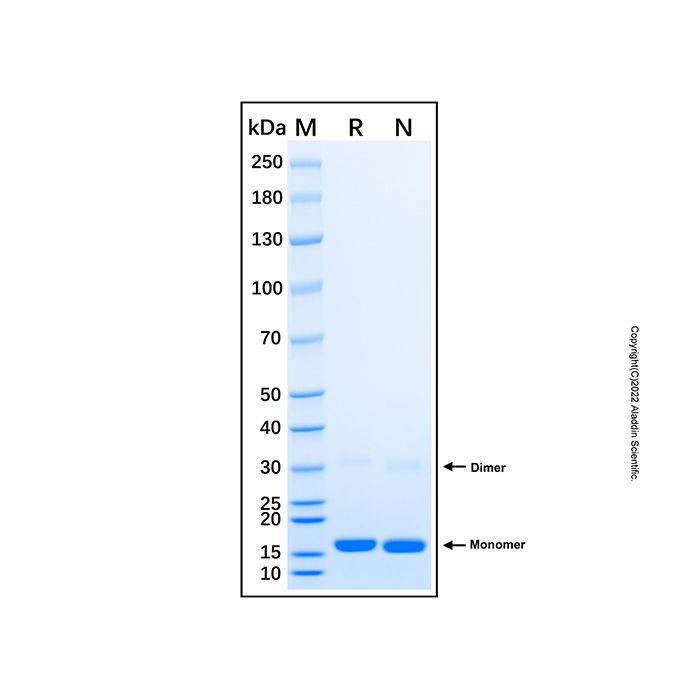
16.1 & 31.8 kDa, under reducing conditions; 16.0 & 30.4 kDa, under non-reducing conditions.
分子类型
蛋白质
产品线
生物产品
储存与运输
物理形态
液体
储存缓冲液
20 mM Tris, 100mM NaCl, 1 mM DTT, 30% Glycerol, pH 8.0
浓度
见COA
储存条件
-20°C储存,避免反复冻融
运输条件
超低温运输
稳定性与储存
-20℃ 存储6个月;收货后建议分装,避免反复冻融。
图片
Recombinant Human DUSP19 Protein (rp189416) - SDS-PAGE 3 μg/lane of Recombinant Human DUSP19 Protein was resolved with SDS-PAGE under reducing (R) and non-reducing (N) conditions and visualized by Coomassie® Blue staining, showing a band at 16.1 & 31.8 kDa under reducing conditions and 16.0 & 30.4 kDa under non-reducing conditions. DUSP19 is a member of the dual-specificity phosphatase family. The key cysteine residues (Cys) located within its catalytic domain exhibit high reactivity and are susceptible to oxidation, which makes them prone to form intermolecular disulfide bonds (Uniprot ID: Q8WTR2).



 危险品化学品经营许可证(带存储)