Double-strand break (DSB) repair protein involved in response to DNA damage, telomere dynamics and class-switch recombination (CSR) during antibody genesis (PubMed:12364621, PubMed:17190600, PubMed:21144835, PubMed:22553214, PubMed:23333306, PubMed:27153538, PubMed:28241136, PubMed:31135337, PubMed:37696958). Plays a key role in the repair of double-strand DNA breaks (DSBs) in response to DNA damage by promoting non-homologous end joining (NHEJ)-mediated repair of DSBs and specifically counteracting the function of the homologous recombination (HR) repair protein BRCA1 (PubMed:22553214, PubMed:23333306, PubMed:23727112, PubMed:27153538, PubMed:31135337). In response to DSBs, phosphorylation by ATM promotes interaction with RIF1 and dissociation from NUDT16L1/TIRR, leading to recruitment to DSBs sites (PubMed:28241136). Recruited to DSBs sites by recognizing and binding histone H2A monoubiquitinated at 'Lys-15' (H2AK15Ub) and histone H4 dimethylated at 'Lys-20' (H4K20me2), two histone marks that are present at DSBs sites (PubMed:17190600, PubMed:23760478, PubMed:27153538, PubMed:28241136). Required for immunoglobulin class-switch recombination (CSR) during antibody genesis, a process that involves the generation of DNA DSBs (PubMed:23345425). Participates in the repair and the orientation of the broken DNA ends during CSR (By similarity). In contrast, it is not required for classic NHEJ and V(D)J recombination (By similarity). Promotes NHEJ of dysfunctional telomeres via interaction with PAXIP1 (PubMed:23727112).
Post-translational: Asymmetrically dimethylated on Arg residues by PRMT1. Methylation is required for DNA binding. Phosphorylated at basal level in the absence of DNA damage (PubMed:11042216, PubMed:11331310). Phosphorylated by ATM in response to DNA damage: phosphorylation at different sites promotes interaction with different set of proteins: phosphorylation at the N-terminus by ATM (residues from 6-178) promotes interaction with PAXIP1 and non-homologous end joining (NHEJ) of dysfunctional telomeres (PubMed:23727112). Phosphorylation by ATM at residues that are located more C-terminus (residues 300-650) leads to promote interaction with RIF1 (PubMed:23333306, PubMed:23727112, PubMed:28241136). Interaction with RIF1 leads to disrupt interaction with NUDT16L1/TIRR (PubMed:28241136). Phosphorylation at Thr-1609 and Ser-1618 in the UDR motif blocks interaction with H2AK15ub (PubMed:24703952). Dephosphorylated by PPP4C (PubMed:24703952). Hyperphosphorylation during mitosis correlates with its exclusion from chromatin and DNA lesions. Hyperphosphorylated in an ATR-dependent manner in response to DNA damage induced by UV irradiation (PubMed:17553757, PubMed:21144835). Dephosphorylated by PPP5C (PubMed:19176521). Phosphorylation at Ser-366 and Thr-670 promotes interaction with TOPBP1 (PubMed:31135337). Phosphorylated by VRK1 (PubMed:31527692). Monoubiquitinated at Lys-1685 by MSL2 is reponse to DNA damage, leading to its stabilization.
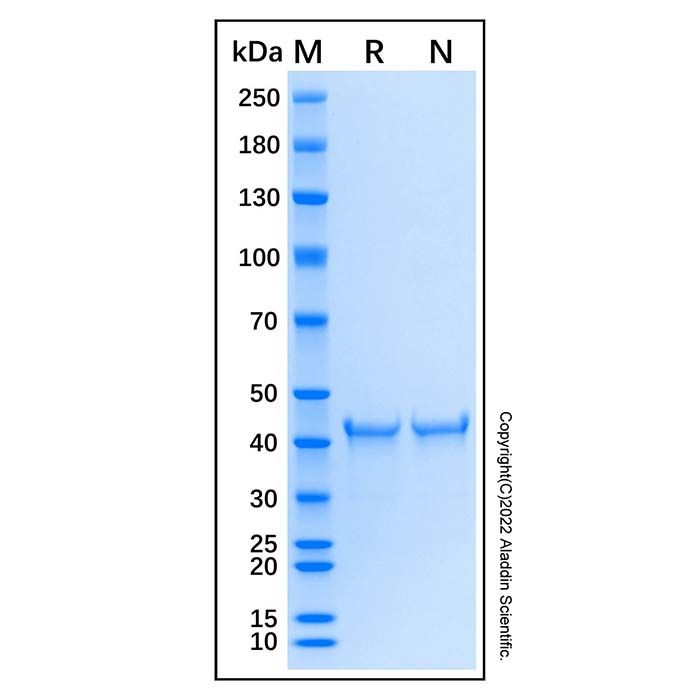
42.1 kDa, under reducing conditions; 42.6 kDa, under non-reducing conditions.
分子类型
蛋白质
产品线
生物产品
储存与运输
物理形态
冻干(Lyophilized)
储存缓冲液
Lyophilized from 20mM Tris, 500mM NaCl, 250mM Imidazole, pH 8.0
浓度
见COA
复溶
We recommend that this vial be briefly centrifuged prior to opening to bring the contents to the bottom. Reconstitute at 1.0 mg/mL in sterile distilled water. Stock solutions should be apportioned into working aliquots and stored at ≤ -20 °C. Further dilutions should be made in appropriate buffered solutions.
储存条件
-20°C储存,避免反复冻融
运输条件
超低温运输
稳定性与储存
Store at -20℃ for 6 months. Upon reconstitution, it is recommended to aliquot. Avoid freeze/thaw cycle.
图片
Recombinant Human 53BP1 Protein (rp189425) - SDS-PAGE 3 μg/lane of Recombinant Human 53BP1 Protein was resolved with SDS-PAGE under reducing (R) and non-reducing (N) conditions and visualized by Coomassie® Blue staining, showing a band at 42.1 kDa under reducing conditions and 42.6 kDa under non-reducing conditions.



 危险品化学品经营许可证(带存储)