TRKA is a member of the neurotrophic tyrosine kinase receptor (NTKR) family. It is a membrane-bound receptor that, upon neurotrophin binding, phosphorylates itself and members of the MAPK pathway. Isoform TrkA-III promotes angiogenesis and has oncogenic activity when overexpressed. Isoform TrkA-I is found in most non-neuronal tissues. Isoform TrkA-II is primarily expressed in neuronal cells. TrkA-III is specifically expressed by the pluripotent neural stem and neural crest progenitors. The presence of NTRK1 leads to cell differentiation and may play a role in specifying sensory neuron subtypes. Mutations in the TRKA gene have been associated with congenital insensitivity to pain, anhidrosis, self-mutilating behavior, mental retardation, and cancer. It was originally identified as an oncogene as it is commonly mutated in cancers, particularly colon and thyroid carcinomas. TRKA is required for high-affinity binding to nerve growth factor (NGF), neurotrophin-3 and neurotrophin-4/5 but not brain-derived neurotrophic factor (BDNF). Known substrates for the Trk receptors are SHC1, PI 3-kinase, and PLC-gamma-1. NTRK1 has a crucial role in the development and function of the nociceptive reception system as well as the establishment of thermal regulation via sweating. It also activates ERK1 by either SHC1- or PLC-gamma-1-dependent signaling pathway. Defects in NTRK1 are a cause of congenital insensitivity to pain with anhidrosis and thyroid papillary carcinoma.
Post-translational: Ligand-mediated autophosphorylation (PubMed:1281417, PubMed:15488758, PubMed:27676246, PubMed:28177573, PubMed:2927393, PubMed:7510697, PubMed:8155326, PubMed:8325889). Interaction with SQSTM1 is phosphotyrosine-dependent. Autophosphorylation at Tyr-496 mediates interaction and phosphorylation of SHC1 (PubMed:15488758, PubMed:7510697, PubMed:8155326, PubMed:8325889). N-glycosylated (PubMed:2927393). Isoform TrkA-I and isoform TrkA-II are N-glycosylated. Ubiquitinated (PubMed:27445338). Undergoes polyubiquitination upon activation; regulated by NGFR (PubMed:27445338). Ubiquitination by NEDD4L leads to degradation (PubMed:27445338). Ubiquitination regulates the internalization of the receptor (By similarity).
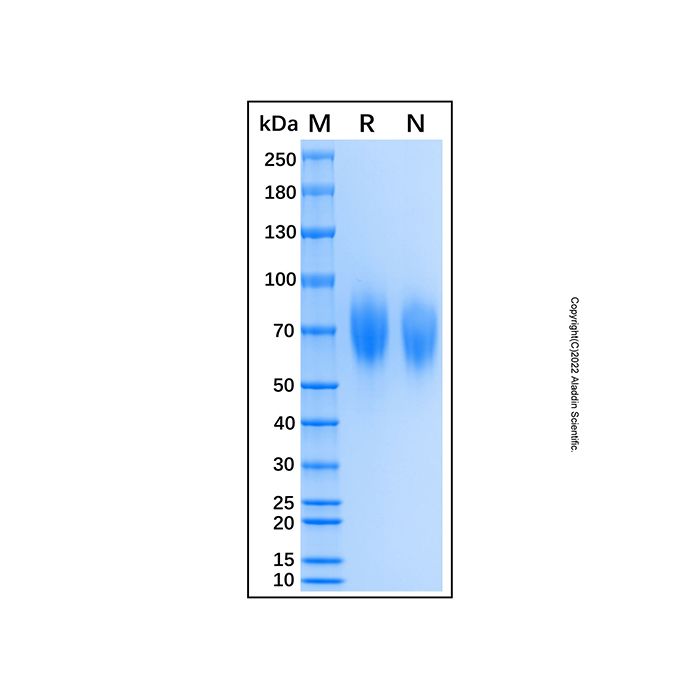
56.6-89.3 kDa, under reducing conditions; 54.2-84.1 kDa, under non-reducing conditions.
分子类型
蛋白质
产品线
生物产品
储存与运输
物理形态
冻干(Lyophilized)
储存缓冲液
Lyophilized from PBS, pH 7.4.
浓度
见COA
复溶
We recommend that this vial be briefly centrifuged prior to opening to bring the contents to the bottom. Reconstitute at 1.0 mg/mL in sterile distilled water. Stock solutions should be apportioned into working aliquots and stored at ≤ -20 °C. Further dilutions should be made in appropriate buffered solutions.
储存条件
-20°C储存,避免反复冻融
运输条件
超低温运输
稳定性与储存
Store at -20℃ for 12 months. Upon reconstitution, it is recommended to aliquot. Avoid freeze/thaw cycle.
图片
Recombinant Human TrkA Protein (rp189427) - SDS-PAGE 3 μg/lane of Recombinant Human TrkA/NTRK1 Protein was resolved with SDS-PAGE under reducing (R) and non-reducing (N) conditions and visualized by Coomassie® Blue staining, showing a band at 56.6-89.3 kDa under reducing conditions and 54.2-84.1 kDa under non-reducing conditions.

 ZJ25F0622963


 危险品化学品经营许可证(带存储)