级别和纯度: 无载体?无载体(Carrier Free)—— 不含添加的载体蛋白/稳定剂。当载体(如 BSA)会干扰偶联或敏感检测时使用。生物活性?生物活性级(Bioactive)—— 经验证在功能检测中保持生物活性。当分子须具有功能活性而不仅是纯度时使用。ActiBioPure™?ActiBioPure™ —— 阿拉丁面向生物活性和重组产品的优质系列。当同时需要高纯度和保持生物活性时使用。His标签?组氨酸(His) 标签级 —— 带有 His 标签的重组蛋白,供亲和纯化/检测。用于纯化、固定或检测带标签蛋白。≥90%(SDS-PAGE)expressed in E. coli, 见 COA
Accession #
P50750
蛋白标签
N-His
表达系统
E. coli
内毒素水平
<1.0 EU/μg
生物活性
Immobilized Recombinant Human Cdk9 Protein (rp189450) at 1.0 μg/mL can bind Recombinant Cdk9 Antibody (Ab095812) with the EC50 of 4.3 ng/mL.
无载体,生物活性,ActiBioPure™,His标签,≥90%(SDS-PAGE),expressed in E. coli, 见 COA
生化机理
CDK9 protein plays a central role in complex transcriptional regulation, coordinating multiple cellular processes. As a key member of the cyclin-dependent kinase pair (CDK9/cyclin-T) complex (also known as positive transcription elongation factor b (P-TEFb)), it promotes the transition from ineffective to effective elongation by phosphorylating the C-terminal domain (CTD) of RNA polymerase II large subunit (POLR2A), SUPT5H, and RDBP.
Post-translational: Autophosphorylation at Thr-186, Ser-347, Thr-350, Ser-353, Thr-354 and Ser-357 triggers kinase activity by promoting cyclin and substrate binding (e.g. HIV TAT) upon conformational changes. Thr-186 phosphorylation requires the calcium Ca2+ signaling pathway, including CaMK1D and calmodulin. This inhibition is relieved by Thr-29 dephosphorylation. However, phosphorylation at Thr-29 is inhibitory within the HIV transcription initiation complex. Phosphorylation at Ser-175 inhibits kinase activity. Can be phosphorylated on either Thr-362 or Thr-363 but not on both simultaneously (PubMed:18566585). Dephosphorylation of Thr-186 by PPM1A and PPM1B blocks CDK9 activity and may lead to CDK9 proteasomal degradation (PubMed:18483222, PubMed:18829461).However, PPP1CA-mediated Thr-186 dephosphorylation is required to release P-TEFb from its inactive P-TEFb/7SK snRNP complex (PubMed:18483222, PubMed:18829461).Dephosphorylated at Ser-347 by the PNUTS-PP1 complex during RNA polymerase II transcription pause-release (PubMed:39603239).Dephosphorylation of C-terminus Thr and Ser residues by protein phosphatase-1 (PP1) triggers CDK9 activity, contributing to the activation of HIV-1 transcription
N6-acetylation of Lys-44 promotes kinase activity, whereas acetylation of both Lys-44 and Lys-48 mediated by PCAF/KAT2B and GCN5/KAT2A reduces kinase activity (PubMed:17452463, PubMed:18250157).The acetylated form associates with PML bodies in the nuclear matrix and with the transcriptionally silent HIV-1 genome; deacetylated upon transcription stimulation (PubMed:17452463, PubMed:18250157).Deacetylated by SIRT7, promoting the kinase activity and subsequent 'Ser-2' phosphorylation of the C-terminal domain (CTD) of RNA polymerase II (PubMed:28426094).Polyubiquitinated and thus activated by UBR5. This ubiquitination is promoted by TFIIS/TCEA1 and favors 'Ser-2' phosphorylation of RPB1/POLR2A CTD.
生物活性
Immobilized Recombinant Human Cdk9 Protein (rp189450) at 1.0 μg/mL can bind Recombinant Cdk9 Antibody (Ab095812) with the EC50 of 4.3 ng/mL.
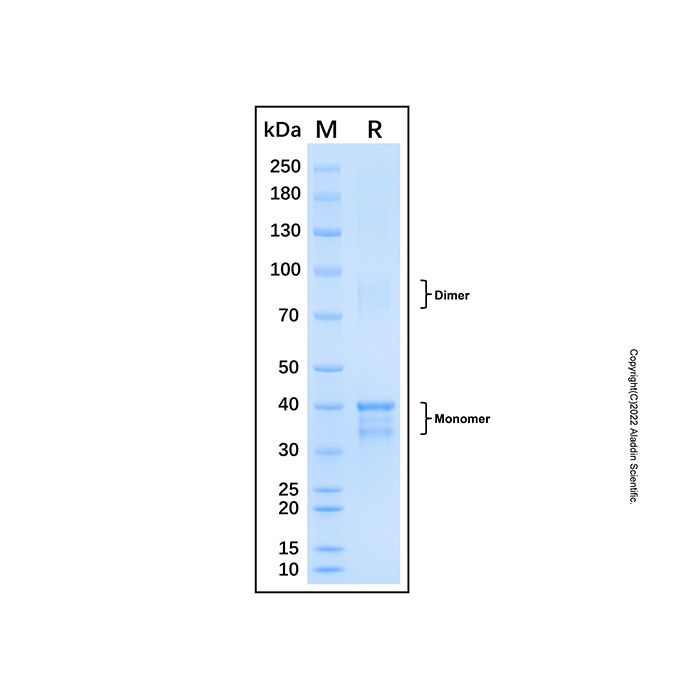
Recombinant Human Cdk9 Protein (rp189450) - SDS-PAGE
3 μg/lane of Recombinant Human Cdk9 Protein was resolved with SDS-PAGE under reducing (R) and visualized by Coomassie® Blue staining, showing the bands at 34.2 & 36.9 & 40.2 & 76.4-90.5 kDa.
As a member of the Cyclin-Dependent Kinase (CDK) family, CDK9 is potentially involved in complex intracellular interactions. The formation of oligomers under Non-Reducing (NR) conditions might be linked to this involvement (Uniprot: P50750).

 ZJ26F0332403


 危险品化学品经营许可证(带存储)