B FABP | B-FABP | BFABP | BLBP | Brain lipid binding protein | Brain lipid-binding protein | Brain-type fatty acid-binding protein | DKFZp547J2313 | FABP 7 | FABP7 | FABP7_HUMAN | FABPB | Fatty Acid Binding Protein 7 | Fatty acid binding protein 7 brain |
规格或纯度
无载体,His标签,≥95%(SDS-PAGE)
生化机理
Fatty acid binding proteins (FABP) are small cytoplasmic lipid binding proteins that are expressed in a tissue specific manner and are involved in intracellular lipid transport. All FABPs bind free fatty acids, cholesterol, and retinoids, which differ in their selectivity, affinity and binding mechanism. Circulating FABP levels are used as indicators of tissue damage. Some FABP polymorphisms have been associated with disorders of lipid metabolism and the development of atherosclerosis. FABPs are structurally conserved, consisting of a water-filled, ligand-binding pocket surrounded by ten anti-parallel beta-barrel structures, capped by an N-terminal helix-turn-helix motif. The helical N-terminus is involved in the regulation of FA transfer from membranes. FABP7, also known as (Brain) B-FABP, Brain lipid-binding protein (BLBP) and mammary-derived growth inhibitor-related (MRG), is a member of FABPs family that is expressed spatially and temporally during brain development and neuronal differentiation. It is involved in fatty acid uptake and intracellular transport and is important in brain development. Human and mouse FABP7 share 86% amino acid sequence identity.
We recommend that this vial be briefly centrifuged prior to opening to bring the contents to the bottom. Reconstitute at 1.0 mg/mL in sterile distilled water. Stock solutions should be apportioned into working aliquots and stored at ≤ -20 °C. Further dilutions should be made in appropriate buffered solutions.
储存条件
-20°C储存,避免反复冻融
运输条件
超低温运输
稳定性与储存
Store at -20°C for 1 year. Avoid freeze/thaw cycle.
图片
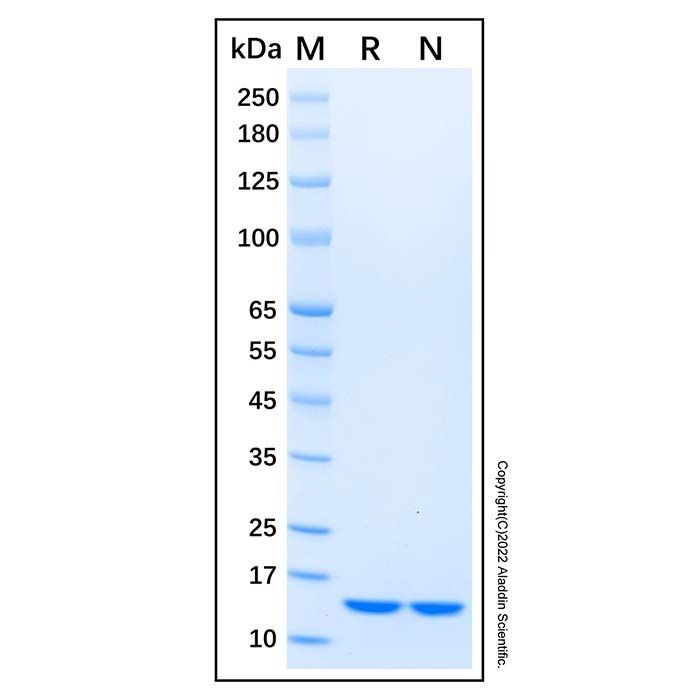
Recombinant Human FABP7/B-FABP Protein (rp192053) - SDS-PAGE 3 μg/lane of Recombinant Human FABP7/B-FABP Protein was resolved with SDS-PAGE under reducing (R) and non-reducing (N) conditions and visualized by Coomassie® Blue staining, showing a band at 13.2 kDa.

 ZJ24F1215490


 危险品化学品经营许可证(带存储)