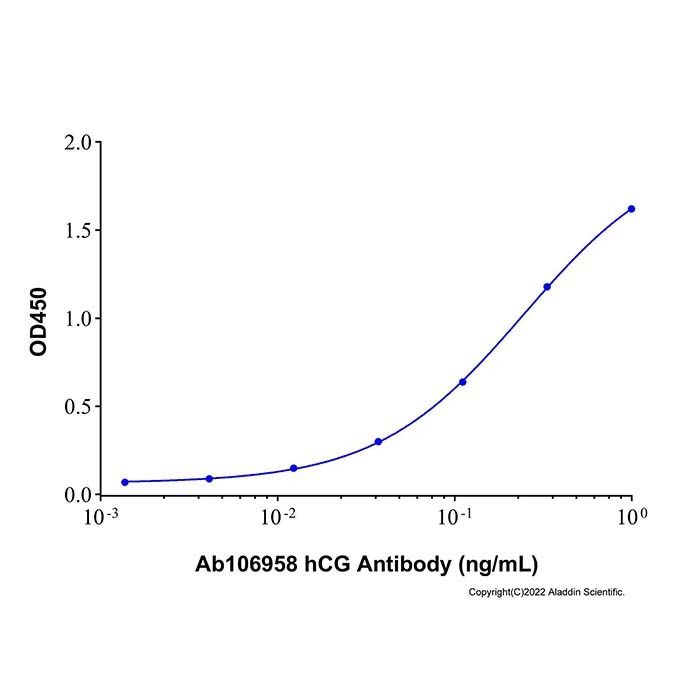
Immobilized Recombinant Human CG alpha/beta (HCG) Heterodimer Protein (rp192055) at 1.0 μg/mL can bind hCG Antibody (Ab106958) with a linear range of 4.1-333.3 ng/mL.
HCG (human chorionic gonadotropin) is a member of the glycoprotein hormone (GPH) family within the cystine knot growth factor superfamily. It is a heterodimer of a 23‑32 kDa unique subunit, CGb, with a 14‑22 kDa alpha subunit, CGa (common glycoprotein hormone alpha) that is shared with GPH family members lutropin (LH), follitropin (FSH) and thyroid stimulating hormone (TSH). CGb occurs only in higher primates, while the most closely related hormone, LHb, is expressed in all mammals. Human CGb and LHb share a receptor, LH/CG‑R or LHR, and show 86% aa sequence identity between aa 21 and 133, before diverging into a 32 aa, highly O‑glycosylated (CGb) or 8 aa (LHb) C‑terminal tail. Mature human CGa shares 69%‑73% aa identity with dog, rabbit, rat, mouse, cow, sheep, pig, cat, and horse CGa. Each subunit forms a cystine knot structure with three disulfide bridges. A “seat‑belt” loop of CGb wraps around CGa, stabilizing subunit non‑covalent association and conferring receptor selectivity. CGb is encoded by six clustered, nonallelic genes that encode identical, but differentially expressed, proteins. HCG produced by cytotrophoblast cells in early pregnancy is hyperglycosylated and sialylated, increasing its acidity and half‑life. Forms with lower glycosylation are produced by syncytiotrophoblasts in continuing pregnancy, and in small amounts by the pituitary where it is also sulfated. Free, variably glycosylated CGb subunits are also reported. The primary role of HCG is to act as an autocrine factor to establish pregnancy and control placental growth and function. HCG has also been shown to induce the angiogenic factor, EG‑VEGF/PK1, and contribute to immune privilege by increasing circulating regulatory T cells and anti‑inflammatory cytokines IL‑10 and IL‑27, via cAMP signaling. In addition to pregnancy, large amounts of HCG are produced in gestational trophoblastic diseases such as choriocarcinoma and hydatiform mole. HCG may also be produced by ovarian and testicular germ cell tumors and advanced cancers that have dedifferentiated.
生物活性
Immobilized Recombinant Human CG alpha/beta (HCG) Heterodimer Protein (rp192055) at 1.0 μg/mL can bind hCG Antibody (Ab106958) with a linear range of 4.1-333.3 ng/mL.
19.1-25.3 & 28.6-38.3 kDa, under reducing conditions; 20.2-28.1 & 46.1-59.5 kDa, under non-reducing conditions.
分子类型
蛋白质
产品线
生物产品
储存与运输
物理形态
粉末
储存缓冲液
Lyophilized from PBS, pH 7.4
浓度
见COA
复溶
We recommend that this vial be briefly centrifuged prior to opening to bring the contents to the bottom. Reconstitute at 0.1 mg/mL in sterile distilled water. Stock solutions should be apportioned into working aliquots and stored at ≤ -20 °C. Further dilutions should be made in appropriate buffered solutions.
储存条件
-20°C储存,避免反复冻融
运输条件
超低温运输
稳定性与储存
-20℃保存12个月;复溶后建议分装,避免反复冻融。
图片
Recombinant Human CG alpha/beta (HCG) Heterodimer Protein (rp192055) - ELISA Immobilized Recombinant Human CG alpha/beta (HCG) Heterodimer Protein (rp192055) at 1.0 μg/mL can bind hCG Antibody (Ab106958) with a linear range of 4.1-333.3 ng/mL.
Recombinant Human CG alpha/beta (HCG) Heterodimer Protein (rp192055) - SDS-PAGE 3 μg/lane of Recombinant Human CG alpha/beta (HCG) Heterodimer Protein was resolved with SDS-PAGE under reducing (R) and non-reducing (N) conditions and visualized by Coomassie® Blue staining, showing a band at 19.1-25.3 & 28.6-38.3 kDa under reducing conditions and 20.2-28.1 & 46.1-59.5 kDa under non-reducing conditions. CGA and CGB3 is also capable of forming heterodimer (PMID: 15662415, PMID: 8202136).

 ZJ25F0521953


 危险品化学品经营许可证(带存储)