As a component of the tetrameric DNA polymerase delta complex (Pol-delta4), plays a role in high fidelity genome replication and repair. Within this complex, increases the rate of DNA synthesis and decreases fidelity by regulating POLD1 polymerase and proofreading 3' to 5' exonuclease activity (PubMed:16510448, PubMed:19074196, PubMed:20334433). Pol-delta4 participates in Okazaki fragment processing, through both the short flap pathway, as well as a nick translation system (PubMed:24035200). Under conditions of DNA replication stress, required for the repair of broken replication forks through break-induced replication (BIR), a mechanism that may induce segmental genomic duplications of up to 200 kb (PubMed:24310611). Involved in Pol-delta4 translesion synthesis (TLS) of templates carrying O6-methylguanine or abasic sites (PubMed:19074196). Its degradation in response to DNA damage is required for the inhibition of fork progression and cell survival (PubMed:24022480).
Post-translational: Ubiquitinated; undergoes 'Lys-48'-linked ubiquitination in response to UV irradiation, leading to proteasomal degradation (PubMed:16934752, PubMed:17317665, PubMed:23233665, PubMed:23913683). This modification is partly mediated by RNF8 and by the DCX(DTL) E3 ubiquitin ligase complex (also called CRL4(CDT2)) (PubMed:23233665, PubMed:24022480). Efficient degradation requires the presence of PCNA and is required for the inhibition of fork progression after DNA damage (PubMed:24022480).
Store at -20℃ for 12 months. Upon receipt, it is recommended to aliquot. Avoid freeze/thaw cycle.
图片
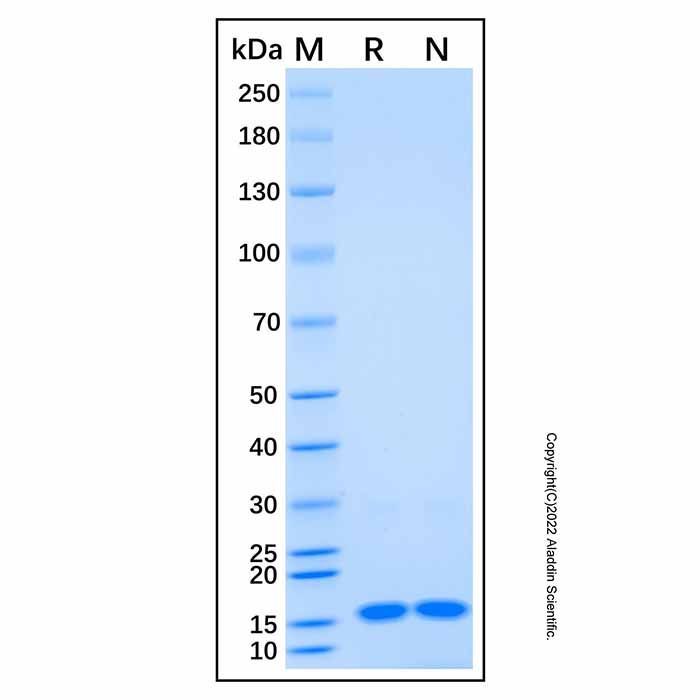
Recombinant Human POLD4 Protein (rp192139) - SDS-PAGE 3 μg/lane of Recombinant Human POLD4 Protein was resolved with SDS-PAGE under reducing (R) and non-reducing (N) conditions and visualized by Coomassie® Blue staining, showing a band at 16.0 kDa.

 ZJ25F0623076


 危险品化学品经营许可证(带存储)