Large ribosomal subunit protein eL34 | 60S ribosomal protein L34 | RPL34
规格或纯度
无载体,≥90%(SDS-PAGE),见COA
生化机理
Ribosomes, the organelles which catalyze protein synthesis, contain a small 40S subunit and a large 60S subunit. Together these subunits are composed of 4 RNA species and nearly 80 structurally different proteins. RPL34 is a member of the L34E family of ribosomal proteins and it encodes a ribosomal protein which is a component of the 60S subunit. RPL34 is found in the cytoplasm and has been mapped to 4q though it was initially believed it is located at 17q21. Transcript variants which are a result of alternative splicing, alternative transcription initiation sites, and/or alternative polyadenylation exist; all encode the same protein. As is typical for genes encoding ribosomal proteins, there are several processed pseudogenes of this gene spread all over the genome. Component of the large ribosomal subunit (PubMed:12962325, PubMed:23636399, PubMed:25901680, PubMed:25957688, PubMed:32669547). The ribosome is a large ribonucleoprotein complex responsible for the synthesis of proteins in the cell (PubMed:12962325, PubMed:23636399, PubMed:25901680, PubMed:25957688, PubMed:32669547).
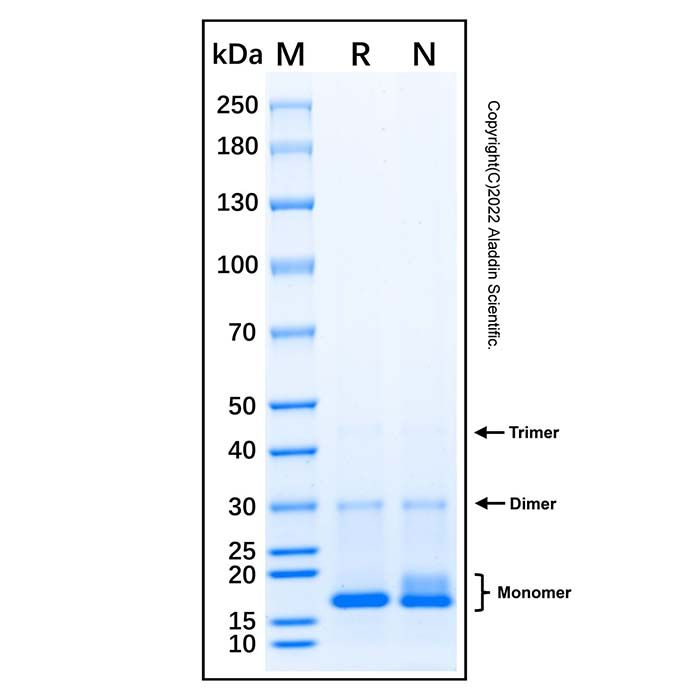
17.0 & 30.3 & 44.6 kDa, under reducing conditions; 17.0 & 18.4 & 30.4 & 44.3 kDa, under non-reducing conditions.
分子类型
蛋白质
产品线
生物产品
储存与运输
物理形态
液体
储存缓冲液
20mM Tris, 0.4M Urea, 10% Glycerol, pH 8.0.
浓度
见COA
储存条件
-20°C储存,避免反复冻融
运输条件
超低温运输
稳定性与储存
-20℃(12个月);收货后建议分装,避免反复冻融。
图片
Recombinant Human RPL34 Protein (rp192210) - SDS-PAGE
3 μg/lane of Recombinant Human RPL34 Protein was resolved with SDS-PAGE under reducing (R) and non-reducing (N) conditions and visualized by Coomassie® Blue staining, showing the bands at 17.0 & 30.3 & 44.6 kDa under reducing conditions and 17.0 & 18.4 & 30.4 & 44.3 kDa under non-reducing conditions.
RPL34 (Ribosomal Protein L34) is a component of the large ribosomal subunit (60S) and belongs to the ribosomal protein family. Many ribosomal proteins are unstable in their free state, with exposed hydrophobic regions that can interact with each other, leading to the formation of aggregates (Uniprot: P49207).

 ZJ26F0131564


 危险品化学品经营许可证(带存储)