级别和纯度: 无载体?无载体(Carrier Free)—— 不含添加的载体蛋白/稳定剂。当载体(如 BSA)会干扰偶联或敏感检测时使用。His标签?组氨酸(His) 标签级 —— 带有 His 标签的重组蛋白,供亲和纯化/检测。用于纯化、固定或检测带标签蛋白。≥90%(SDS-PAGE)expressed in E. coli; 见COA
无载体,His标签,≥90%(SDS-PAGE),expressed in E. coli; 见COA
生化机理
COP9 Signalosome Subunit 7A (COPS7A) is a component of the COP9 signalosome complex (CSN), a complex involved in a variety of cellular and developmental processes. The CSN complex is a vital regulator of the ubiquitin (Ubl) conjugation pathway by mediating the deneddylation of the cullin subunits of SCF-type E3 ligase complexes, thus leading to decrease in the Ubl ligase activity of SCF-type complexes such as SCF, CSA or DDB2. This complex is also involved in phosphorylation of p53/TP53, JUN, I-kappa-B-alpha/NFKBIA, ITPK1 and IRF8/ICSBP, probably through its association with CK2 and PKD kinases. CSN-dependent phosphorylation of TP53 and JUN stimulates and protects degradation by the Ubl system, respectively.
Post-translational: Phosphorylated by CK2 and PKD kinases.
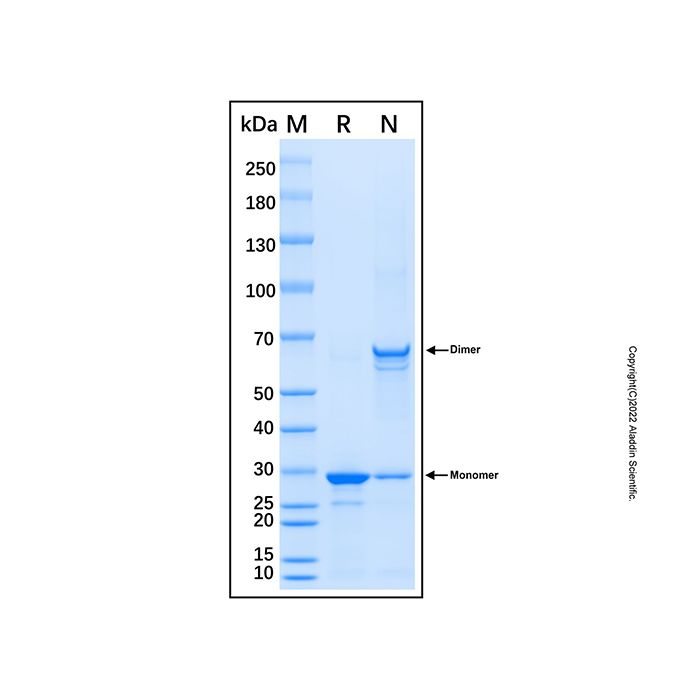
29.0 kDa, under reducing conditions; 29.0 & 63.6 kDa, under non-reducing conditions.
分子类型
蛋白质
产品线
生物产品
储存与运输
物理形态
液体
储存缓冲液
20mM Tris, 0.4M Urea, 10% Glycerol, pH 8.0
浓度
expressed in E. coli; 见COA
复溶
We recommend that this vial be briefly centrifuged prior to opening to bring the contents to the bottom. Reconstitute at 0.1 mg/mL in sterile distilled water. Stock solutions should be apportioned into working aliquots and stored at ≤ -20 °C. Further dilutions should be made in appropriate buffered solutions.
储存条件
-20°C储存,避免反复冻融
运输条件
超低温运输
稳定性与储存
-20℃ 存储6个月;收货后建议分装,避免反复冻融。
图片
Recombinant Human COPS7A Protein (rp192259) - SDS-PAGE
3 μg/lane of Recombinant Human COPS7A Protein was resolved with SDS-PAGE under reducing (R) and non-reducing (N) conditions and visualized by Coomassie® Blue staining, showing a band at 29.0 kDa under reducing conditions and 29.0 & 63.6 kDa under non-reducing conditions.
COPS7A contains a typical coiled-coil structure, formed by repeating heptad sequences (e.g., positions a–g), where the a and d positions are predominantly occupied by hydrophobic residues (such as leucine or isoleucine). These residues mediate hydrophobic interactions to stabilize the interface between helices. This structural motif exhibits a spontaneous tendency to form either homodimers or heterodimers (Uniprot:Q9UBW8).



 危险品化学品经营许可证(带存储)