Bruton's tyrosine kinase (or BTK) is a type of kinase protein expressed in B lymphocytes and T cells. BTK contains a PH domain which binds phosphatidylinositol(3,4,5)-trisphosphate (PIP3). After binding to PIP3, BTK is induced to phosphorylate phospholipase C, which in turn hydrolyzes PIP2 into two second messagers, IP3 and DAG, which then modulate the activity of downstream proteins during B-cell signaling. Btk is also found implicated in the primary immunodeficiency disease X-linked agammaglobulinemia(Bruton's agammaglobulinemia). BTK played a key role in B-cell maturation as well as mast cell activation through the high-affinity IgE receptor. Patients with X-linked agammaglobulinemia have normal pre-B cell populations in their bone marrow but these B-cells can not mature and enter the circulation.
Post-translational: Following B-cell receptor (BCR) engagement, translocates to the plasma membrane where it gets phosphorylated at Tyr-551 by LYN and SYK. Phosphorylation at Tyr-551 is followed by autophosphorylation of Tyr-223 which may create a docking site for a SH2 containing protein. Phosphorylation at Ser-180 by PRKCB, leads in translocation of BTK back to the cytoplasmic fraction. Phosphorylation at Ser-21 and Ser-115 creates a binding site for PIN1 at these Ser-Pro motifs, and promotes it's recruitment.
We recommend that this vial be briefly centrifuged prior to opening to bring the contents to the bottom. Reconstitute at 1.0 mg/mL in sterile distilled water. Stock solutions should be apportioned into working aliquots and stored at ≤ -20 °C. Further dilutions should be made in appropriate buffered solutions.
储存条件
-20°C储存,避免反复冻融
运输条件
超低温运输
稳定性与储存
-20℃保存 12个月;复溶后建议分装,避免反复冻融。
图片
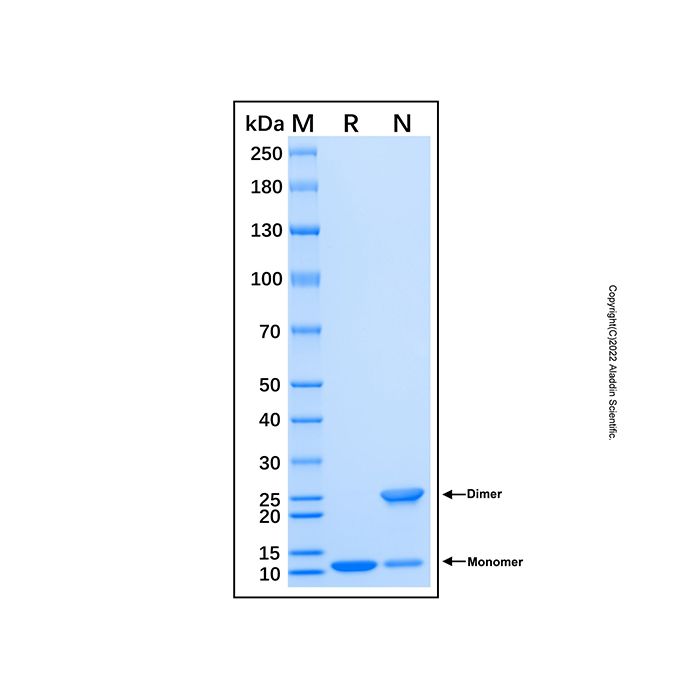
Recombinant Human BTK Protein (rp192263) - SDS-PAGE 3 μg/lane of Recombinant Human BTK Protein was resolved with SDS-PAGE under reducing (R) and non-reducing (N) conditions and visualized by Coomassie® Blue staining, showing a band at 11.4 kDa under reducing conditions and 11.8 & 25.2 kDa under non-reducing conditions. BTK dimerizes in cells using the PH–TH module and whether this dimerization is necessary for signaling (PMID: 39808693).

 ZJ25F0623421


 危险品化学品经营许可证(带存储)