Osteopontin, also known as Secreted phosphoprotein 1, Bone sialoprotein 1, BSP-1, OPN, and SPP1, is a member of the osteopontin family and a SIBLING glycoprotein. Osteopontin has been classified as T-helper 1 cytokine and thus believed to exacerbate inflammation in several chronic inflammatory diseases, including atherosclerosis. Besides proinflammatory functions, physiologically Osteopontin is a potent inhibitor of mineralization, it prevents ectopic calcium deposits and is a potent inducible inhibitor of vascular calcification. Osteopontin is expressed and secreted by various cells, and has a role in cell adhesion, chemotaxis, prevention of apoptosis, invasion, migration and anchorage-independent growth of tumor cells. Osteopontin recruitment functions of inflammatory cells are thought to be mediated through its adhesive domains, especially the arginine-glycine-aspartate (RGD) sequence that interacts with several integrin heterodimers. Osteopontin has emerged as a potential biomarker and mediator in cardiovascular disease. In the context of atherosclerosis, OPN is generally regarded as a proinflammatory and proatherogenic molecule. However, the role of OPN in vascular calcification (VC), which is closely related to chronic and active inflammation, is that of a negative regulator because it is an inhibitor of calcification and an active inducer of decalcification. Extensive research has demonstrated the pivotal participation of Osteopontin in the regulation of cell signaling which controls neoplastic and malignant transformation. The elevated expression of Osteopontin has been observed in a variety of cancers. It has been linked with tumor metastasis and signifies a poor prognosis for the patient.
Post-translational: Forms covalent cross-links mediated by transglutaminase TGM2, between a glutamine and the epsilon-amino group of a lysine residue, forming homopolymers and heteropolymers, increasing its collagen binding properties. Extensively phosphorylated by FAM20C in the extracellular medium at multiple sites within the S-x-E/pS motif (PubMed:15869464, PubMed:22582013, PubMed:26091039).
The phosphorylated form inhibits hydroxyapatite crystallization. Dephosphorylation via a mechanism involving ALPL/TNAP promotes hydroxyapatite crystallization (By similarity). O-glycosylated. Isoform 5 is GalNAc O-glycosylated at Thr-59 or Ser-62.
生物活性
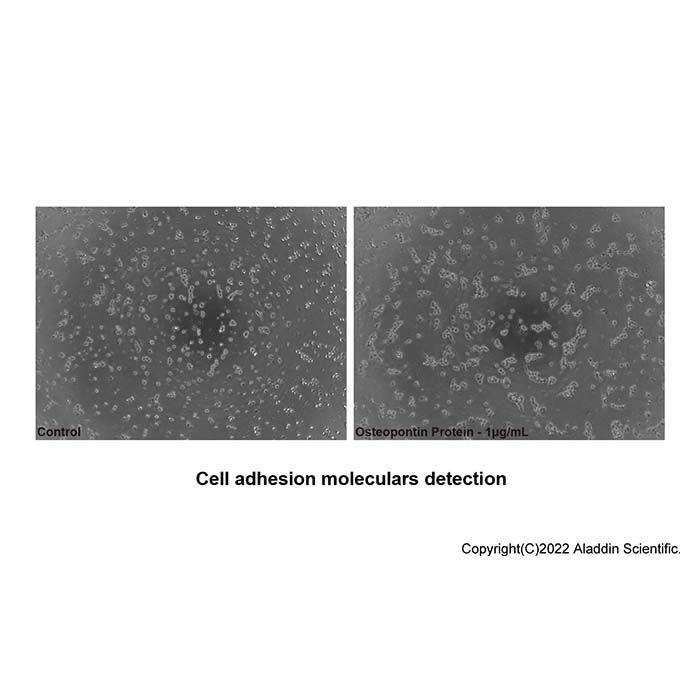
Measured by the ability of the immobilized protein to support the adhesion of HEK293 human embryonic kidney cells. The ED50 for this effect is1 µg/mL.
50.9-61.8 kDa, under reducing conditions; 50.7-60.6 kDa, under non-reducing conditions.
分子类型
蛋白质
产品线
生物产品
储存与运输
物理形态
冻干(Lyophilized)
储存缓冲液
Lyophilized from PBS, pH 7.4.
浓度
见COA
复溶
We recommend that this vial be briefly centrifuged prior to opening to bring the contents to the bottom. Reconstitute at 1.0 mg/mL in sterile distilled water. Stock solutions should be apportioned into working aliquots and stored at ≤ -20 °C. Further dilutions should be made in appropriate buffered solutions.
储存条件
-20°C储存,避免反复冻融
运输条件
超低温运输
稳定性与储存
-20℃保存 12个月;复溶后建议分装,避免反复冻融。
图片
Recombinant Human Osteopontin (OPN-a) Protein (rp213140) - Protein Bioactivity Measured by the ability of the immobilized protein to support the adhesion of HEK293 human embryonic kidney cells. The ED₅₀ for this effect is 1.0 µg/mL.
Recombinant Human Osteopontin (OPN-a) Protein (rp213140) - SDS-PAGE 3 μg/lane of Recombinant Human Osteopontin (OPN-a) Protein was resolved with SDS-PAGE under reducing (R) and non-reducing (N) conditions and visualized by Coomassie® Blue staining, showing a band at 50.9-61.8 kDa under reducing conditions and 50.7-60.6 kDa under non-reducing conditions.

 ZJ25F0927295


 危险品化学品经营许可证(带存储)