EC 3.1.3.48 | protein tyrosine phosphatase PTPsigma | protein tyrosine phosphatase, receptor type, S | protein tyrosine phosphatase, receptor type, sigma | PTP sigma | PTPR sigma | PTPRS | PTPSIGMA | receptor-type tyrosine-protein phosphatase S | Receptor
规格或纯度
无动物源,无载体,His标签,≥90%(SDS-PAGE),见COA
生化机理
Phosphatase Receptor-type sigma (PTPR sigma ), also known as PTP sigma, is a 200 kDa type I transmembrane glycoprotein that is a member of the class 2A (LAR) subfamily of the protein tyrosine phosphatase (PTP) family. Human PTPR sigma cDNA encodes 1948 amino acids (aa) including a 29 aa signal sequence, a 1253 aa extracellular domain (ECD) with three C2-type Ig domains and eight Fibronectin (Fn) type III domains, a transmembrane domain, and a cytoplasmic region with two PTP domains. Multiple differentially expressed splice variants lack sections of the Ig and/or Fn domains and/or cytoplasmic juxtamembrane sequence. PKC activation in the cell promotes endoprotease cleavage of PTPR sigma, releasing the 140-160 kDa ECD. The human PTPR sigma ECD shares 93% aa sequence identity with the nearest isoform of mouse and rat PTPR sigma, 96% with bovine PTPR sigma, and 97% with porcine PTPR sigma. Activity of PTPR sigma can be inhibited by bisphosphonates. PTPR sigma is a receptor for several proteins, including neural chondroitin sulfate proteoglycans which inhibit nerve regeneration. It also binds and dephosphorylates targets such as N-Cadherin, E-Cadherin, EGF R and Ret. Through these interactions PTPR sigma affects pituitary and neuroendocrine development, and axon growth and targeting. Mice deleted for PTPR sigma show pituitary, pancreatic, and gut abnormalities, mainly due to growth hormone insufficiency. They also show enhanced regeneration, but faulty targeting, of injured peripheral nerves. Head and neck squamous cell cancers frequently underexpress PTPR sigma. Since PTPR sigma inhibits EGF R signaling pathways, its underexpression can enhance tumor cell growth.
Post-translational: A cleavage occurs, separating the extracellular domain from the transmembrane segment. This process called 'ectodomain shedding' is thought to be involved in receptor desensitization, signal transduction and/or membrane localization (By similarity).
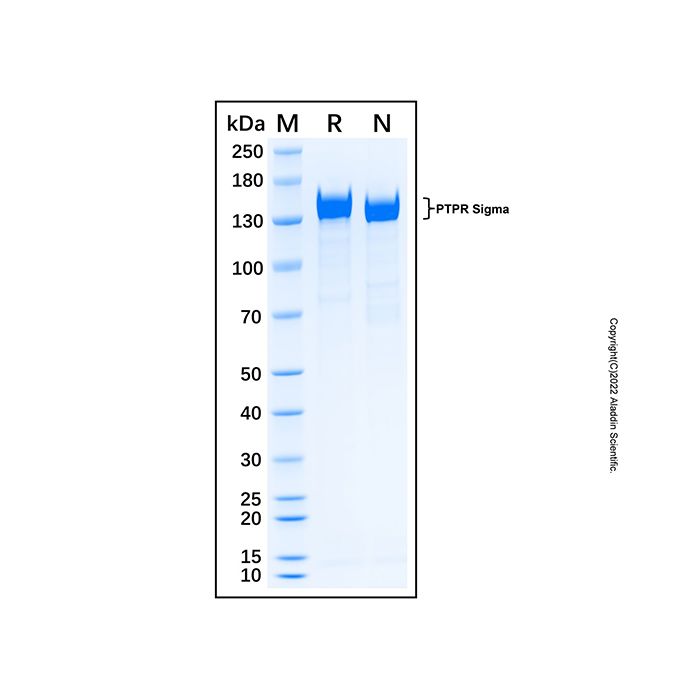
132.2-157.4 kDa, under reducing conditions; 129.0-155.8 kDa, under non-reducing conditions.
分子类型
蛋白质
产品线
生物产品
储存与运输
物理形态
冻干(Lyophilized)
储存缓冲液
Lyophilized from PBS, 10% Trehalose, pH 7.4
浓度
见COA
复溶
We recommend that this vial be briefly centrifuged prior to opening to bring the contents to the bottom. Reconstitute at 1.0 mg/mL in sterile distilled water. Stock solutions should be apportioned into working aliquots and stored at ≤ -20 °C. Further dilutions should be made in appropriate buffered solutions.
储存条件
-20°C储存,避免反复冻融
运输条件
超低温运输
稳定性与储存
-20℃保存 12个月;复溶后建议分装,避免反复冻融。
图片
Recombinant Human PTPR Sigma Protein (rp188468) - SDS-PAGE 3 μg/lane of Recombinant Human PTPR Sigma Protein was resolved with SDS-PAGE under reducing (R) and non-reducing (N) conditions and visualized by Coomassie® Blue staining, showing a band at 132.2-157.4 kDa under reducing conditions and 129.0-155.8 kDa under non-reducing conditions.

 ZJ25F1028380


 危险品化学品经营许可证(带存储)