无动物源,无载体,His标签,≥95%(SDS-PAGE),expressed in HEK293, 见 COA
生化机理
Advanced glycation endproducts (AGE) are adducts formed by the non-enzymatic glycation or oxidation of macromolecules. AGE forms during aging and its formation is accelerated under pathophysiologic states such as diabetes, Alzheimer’s disease, renal failure and immune/inflammatory disorders. Receptor for Advanced Glycation Endoproducts (RAGE), named for its ability to bind AGE, is a multiligand receptor belonging the immunoglobulin (Ig) superfamily. Besides AGE, RAGE binds amyloid beta -peptide, S100/calgranulin family proteins, high mobility group B1 (HMGB1, also know as amphoterin) and leukocyte integrins.The mouse RAGE gene encodes a 403 amino acid (aa) residue type I transmembrane glycoprotein with a 22 aa signal peptide, a 319 aa extracellular domain containing a Ig-like V-type domain and two Ig-like Ce-type domains, a 21 aa transmembrane domain and a 41 aa cytoplasmic domain. The V-type domain and the cytoplasmic domain are important for ligand binding and for intracellular signaling, respectively. Two alternative splice variants, lacking the V-type domain or the cytoplasmic tail, are known. RAGE is highly expressed in the embryonic central nervous system. In adult tissues, RAGE is expressed at low levels in multiple tissues including endothelial and smooth muscle cells, mononuclear phagocytes, pericytes, microglia, neurons, cardiac myocytes and hepatocytes. The expression of RAGE is upregulated upon ligand interaction. Depending on the cellular context and interacting ligand, RAGE activation can trigger differential signaling pathways that affect divergent pathways of gene expression. RAGE activation modulates varied essential cellular responses (including inflammation, immunity, proliferation, cellular adhesion and migration) that contribute to cellular dysfunction associated with chronic diseases such as diabetes, cancer, amyloidoses and immune or inflammatory disorders.
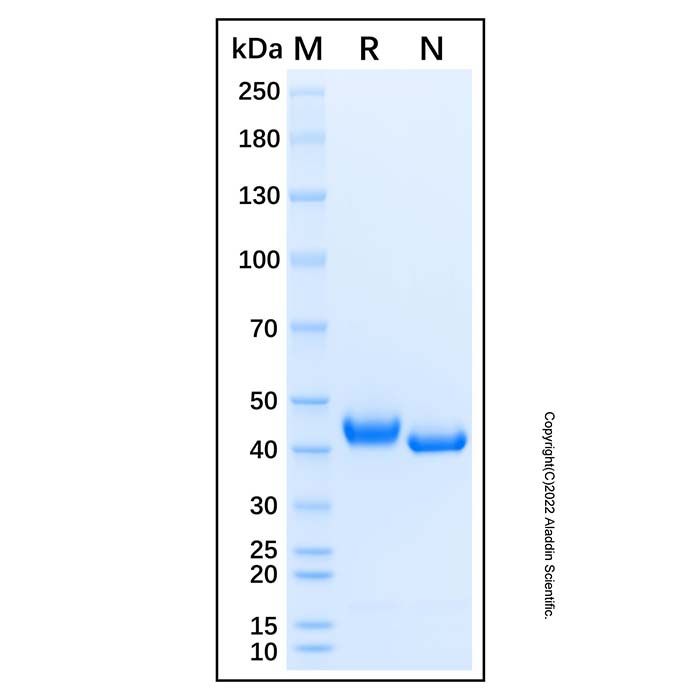
43.3 kDa, under reducing conditions; 41.1 kDa, under non-reducing conditions.
分子类型
蛋白质
产品线
生物产品
储存与运输
物理形态
冻干(Lyophilized)
储存缓冲液
Lyophilized from PBS, pH 7.4
浓度
expressed in HEK293, 见 COA
复溶
We recommend that this vial be briefly centrifuged prior to opening to bring the contents to the bottom. Reconstitute at 0.5 mg/mL in sterile distilled water. Stock solutions should be apportioned into working aliquots and stored at ≤ -20 °C. Further dilutions should be made in appropriate buffered solutions.
储存条件
-20°C储存,避免反复冻融
运输条件
超低温运输
稳定性与储存
-20℃保存 12个月;复溶后建议分装,避免反复冻融。
图片
Recombinant Mouse RAGE Protein (rp214432) - SDS-PAGE
3 μg/lane of Recombinant Mouse RAGE Protein was resolved with SDS-PAGE under reducing (R) and non-reducing (N) conditions and visualized by Coomassie® Blue staining, showing a band at 43.3 kDa under reducing conditions and 41.1 kDa under non-reducing conditions.

 ZJ26F0333113


 危险品化学品经营许可证(带存储)