I kappa B kinase 2 | I kappa B kinase beta | I-kappa-B kinase 2 | I-kappa-B-kinase beta | IkBKB | IKK beta | IKK-B | IKK-beta | IKK2 | IKKB | IKKB_HUMAN | IMD15 | Inhibitor of kappa light polypeptide gene enhancer in B cells, kinase beta | Inhibitor of nu
规格或纯度
无载体,His标签,≥80%(SDS-PAGE),见COA
生化机理
Acts as part of the IKK complex in the conventional pathway of NF-kappa-B activation and phosphorylates inhibitors of NF-kappa-B thus leading to the dissociation of the inhibitor/NF-kappa-B complex and ultimately the degradation of the inhibitor. Also phosphorylates NCOA3.
Post-translational: Upon cytokine stimulation, phosphorylated on Ser-177 and Ser-181 by MEKK1 and/or MAP3K14/NIK; which enhances activity. Once activated, autophosphorylates on the C-terminal serine cluster; which decreases activity and prevents prolonged activation of the inflammatory response. Acetylation of Thr-180 by Yersinia yopJ prevents phosphorylation and activation, thus blocking the I-kappa-B pathway. Ubiquitinated. Monoubiquitination involves TRIM21 that leads to inhibition of Tax-induced NF-kappa-B signaling. According to PubMed:19675099, 'Ser-163' does not serve as a monoubiquitination site. According to PubMed:16267042, ubiquitination on 'Ser-163' modulates phosphorylation on C-terminal serine residues. Monoubiquitination by TRIM21 is dirupted by Yersinia yopJ.
We recommend that this vial be briefly centrifuged prior to opening to bring the contents to the bottom. Reconstitute at 1.0 mg/mL in sterile distilled water. Stock solutions should be apportioned into working aliquots and stored at ≤ -20 °C. Further dilutions should be made in appropriate buffered solutions.
储存条件
-20°C储存,避免反复冻融
运输条件
超低温运输
稳定性与储存
Store at -20℃ for 6 months. Upon reconstitution, it is recommended to aliquot. Avoid freeze/thaw cycle.
图片
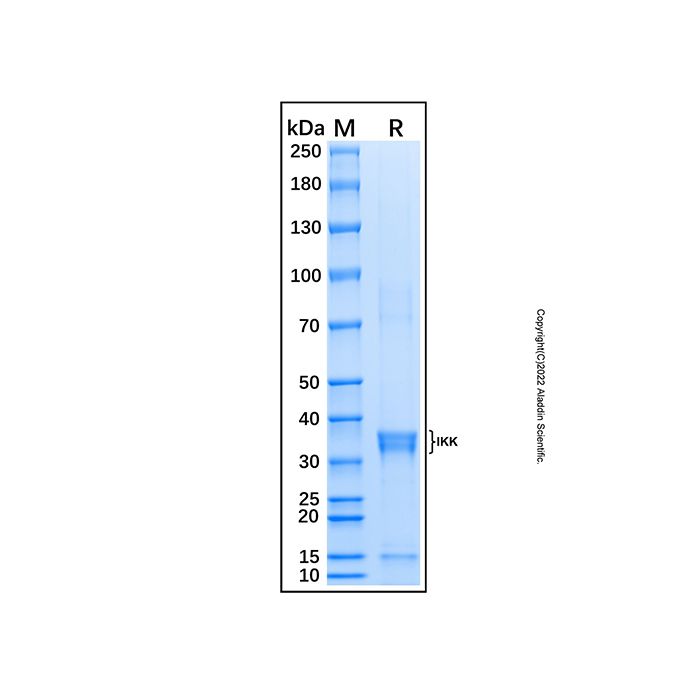
Recombinant Human IKK beta Protein (rp214439) - SDS-PAGE 3 μg/lane of Recombinant Human IKK beta Protein was resolved with SDS-PAGE under reducing (R) conditions and visualized by Coomassie® Blue staining, showing a band at 33.1 & 35.9 kDa. Under reducing conditions, disulfide bonds are disrupted, potentially leading to more pronounced protein degradation (Uniprot ID: O14920).



 危险品化学品经营许可证(带存储)