AP endonuclease 1 | APE | APE1 | APE-1 | APEAPEX nuclease (multifunctional DNA repair enzyme) | APENAP endonuclease class I | APEX deoxyribonuclease (apurinic or apyrimidinic) | APEX nuclease (multifunctional DNA repair enzyme) 1 | APEX nuclease | APEX1 |
规格或纯度
无载体, ≥90%(SDS-PAGE), 见COA
生化机理
Human APE (also known as Ref-1) is the apurinic/apyrimidinic (AP) endonuclease required for efficient DNA base excision repair (BER). Following the removal of a damaged base by a DNA glycosylase, APE cleaves the AP site to allow resynthesis and ligation to complete repair. In addition, APE/Ref-1 acts as a factor that regulates the redox state of multiple transcription factors, including c-Jun, c-Fos, NF-kappa B, and p53.
Post-translational: Phosphorylated. Phosphorylation by kinase PKC or casein kinase CK2 results in enhanced redox activity that stimulates binding of the FOS/JUN AP-1 complex to its cognate binding site. AP-endodeoxyribonuclease activity is not affected by CK2-mediated phosphorylation. Phosphorylation of Thr-233 by CDK5 reduces AP-endodeoxyribonuclease activity resulting in accumulation of DNA damage and contributing to neuronal death.Acetylated on Lys-6 and Lys-7. Acetylation is increased by the transcriptional coactivator EP300 acetyltransferase, genotoxic agents like H2O2 and methyl methanesulfonate (MMS). Acetylation increases its binding affinity to the negative calcium response element (nCaRE) DNA promoter. The acetylated form induces a stronger binding of YBX1 to the Y-box sequence in the MDR1 promoter than the unacetylated form. Deacetylated on lysines. Lys-6 and Lys-7 are deacetylated by SIRT1.Cleaved at Lys-31 by granzyme A to create the mitochondrial form; leading to reduction of binding to DNA, AP endodeoxynuclease activity, redox activation of transcription factors and to enhanced cell death. Cleaved by granzyme K; leading to intracellular ROS accumulation and enhanced cell death after oxidative stress.Cys-65 and Cys-93 are nitrosylated in response to nitric oxide (NO) and lead to the exposure of the nuclear export signal (NES).Ubiquitinated by MDM2; leading to translocation to the cytoplasm and proteasomal degradation.
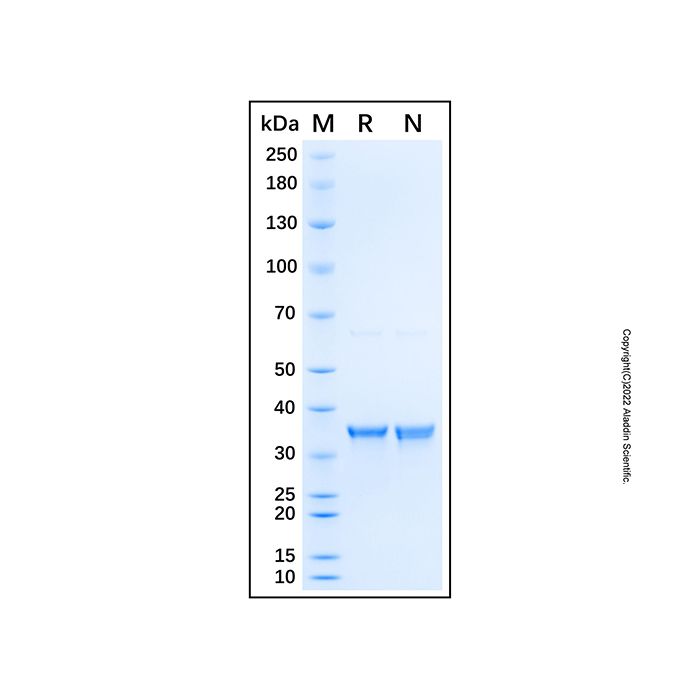
Recombinant Human APEX1 Protein (rp214476) - SDS-PAGE 3 μg/lane of Recombinant Human APEX1 Protein was resolved with SDS-PAGE under reducing (R) and non-reducing (N) conditions and visualized by Coomassie® Blue staining, showing a band at 34.7 kDa.

 ZJ25F0926817


 危险品化学品经营许可证(带存储)