Lck (p56lck) is a member of the Src family of non-receptor tyrosine kinases. It was identified as a gene rearranged and over-expressed in the murine lymphoma LSTRA, most likely as a result of the insertion of Moloney murine leukemia virus DNA immediately adjacent to the gene. Lck behaves as a proto-oncogene and can lead to cell transformation upon activation. A number of human cancer cell lines show over-expression of Lck, pointing to a possible role for this kinase in the initiation and maintenance of the transformed state in human cancers.
Post-translational: Autophosphorylated on Tyr-394, increasing enzymatic activity, this site is dephosphorylated by PTN22. Phosphorylated on Tyr-505 by CSK, decreasing activity. Dephosphorylated by PTPRC/CD45. Dephosphorylation at Tyr-394 by PTPN2 negatively regulates T-cell receptor signaling. Dephosphorylation at Tyr-394 by DUSP22 negatively regulates T-cell receptor signaling (PubMed:24714587, PubMed:38225265). Myristoylation is required prior to palmitoylation.Palmitoylation regulates association with the plasma membrane and could be mediated by ZDHHC2.'Lys-63'-linked ubiquitinated at Lys-99 and Lys-276 by UBR2; this modification is required for autophosphorylation at Tyr-394.
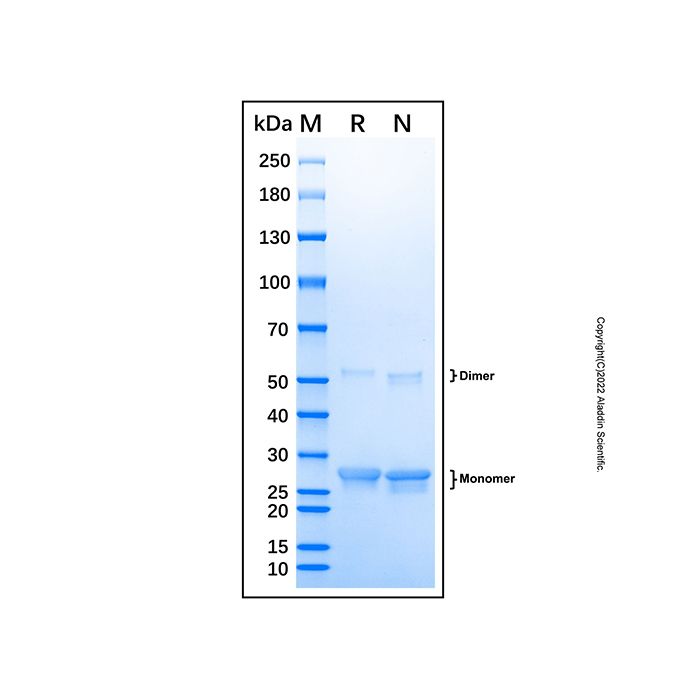
Recombinant Human Lck Protein (rp214492) - SDS-PAGE 3 μg/lane of Recombinant Human Lck Protein was resolved with SDS-PAGE under reducing (R) and non-reducing (N) conditions and visualized by Coomassie® Blue staining, showing a band at 27.1 & 53.0 kDa under reducing conditions and 25.7 & 27.0 & 49.9 & 51.8 kDa under non-reducing conditions. The dimerization of Lck is mediated by the binding of its SH2 domain to phosphotyrosine, Which is also the reason for the two conformations under non-reducing conditions (PMID: 7512222).



 危险品化学品经营许可证(带存储)