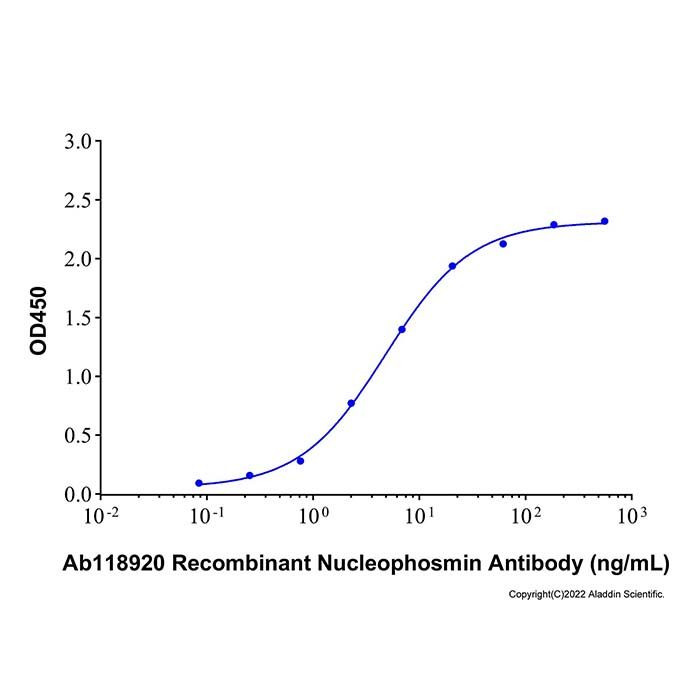
Immobilized Recombinant Human Nucleophosmin/NPM1 Protein (rp214495) at 1.0 μg/mL can bind Recombinant Nucleophosmin Antibody (Ab118920) with the EC50 of 4.8 ng/mL.
Nucleophosmin 1 (NPM1), also known as nucleolar phosphoprotein B23 or numatrin, is a member of the nucleoplasmin family. Nucleophosmin (NPM) is a nucleolar phosphoprotein that plays multiple roles in ribosome assembly and transport, cytoplasmic-nuclear trafficking, centrosome duplication, and regulation of p53. The NPM1 gene is frequently involved in chromosomal translocation, mutation, and deletion. Mutations of the NPM1 gene leading to the expression of a cytoplasmic mutant protein, NPMc+, are the most frequent genetic abnormalities found in acute myeloid leukemias. Acute myeloid leukemia (AML) with mutated NPM1 have distinct characteristics, including a significant association with a normal karyotype, the involvement of different hematopoietic lineages, a specific gene-expression profile, and clinically, a better response to induction therapy, and a favorable prognosis. Also, NPM1 is a crucial gene to consider in the context of the genetics and biology of cancer. NPM1 is frequently overexpressed, mutated, rearranged, and deleted in human cancer. Traditionally regarded as a tumor marker and a putative proto-oncogene, it has now also been attributed with tumor-suppressor functions.
Post-translational: Acetylated at C-terminal lysine residues, thereby increasing affinity to histones. ADP-ribosylated. Phosphorylated at Ser-4 by PLK1 and PLK2. Phosphorylation at Ser-4 by PLK2 in S phase is required for centriole duplication and is sufficient to trigger centriole replication. Phosphorylation at Ser-4 by PLK1 takes place during mitosis. Phosphorylated by CDK2 at Ser-125 and Thr-199. Phosphorylation at Thr-199 may trigger initiation of centrosome duplication. Phosphorylated by CDK1 at Thr-199, Thr-219, Thr-234 and Thr-237 during cell mitosis. When these four sites are phosphorated, RNA-binding activity seem to be abolished. May be phosphorylated at Ser-70 by NEK2. The Thr-199 phosphorylated form has higher affinity for ROCK2. CDK6 triggers Thr-199 phosphorylation when complexed to Kaposi's sarcoma herpesvirus (KSHV) V-cyclin, leading to viral reactivation by reducing viral LANA levels. Sumoylated by ARF. Ubiquitinated. Ubiquitination leads to proteasomal degradation. Deubiquitinated by USP36 (PubMed:19208757).
生物活性
Immobilized Recombinant Human Nucleophosmin/NPM1 Protein (rp214495) at 1.0 μg/mL can bind Recombinant Nucleophosmin Antibody (Ab118920) with the EC50 of 4.8 ng/mL.
We recommend that this vial be briefly centrifuged prior to opening to bring the contents to the bottom. Reconstitute at 1.0 mg/mL in sterile distilled water. Stock solutions should be apportioned into working aliquots and stored at ≤ -20 °C. Further dilutions should be made in appropriate buffered solutions.
储存条件
-20°C储存,避免反复冻融
运输条件
超低温运输
稳定性与储存
-20℃保存 12个月;复溶后建议分装,避免反复冻融。
图片
Recombinant Human Nucleophosmin/NPM1 Protein (rp214495) - ELISA
Immobilized Recombinant Human Nucleophosmin/NPM1 Protein (rp214495) at 1.0 μg/mL can bind Recombinant Nucleophosmin Antibody (Ab118920) with the EC₅₀ of 4.8 ng/mL.
Recombinant Human Nucleophosmin/NPM1 Protein (rp214495) - SDS-PAGE
3 μg/lane of Recombinant Human Nucleophosmin/NPM1 Protein was resolved with SDS-PAGE under reducing (R) conditions and visualized by Coomassie® Blue staining, showing a band at 34.7 kDa.

 ZJ26F0130756


 危险品化学品经营许可证(带存储)