Anaplastic Lymphoma Kinase (ALK), also known as CD246, is a transmembrane receptor tyrosine kinase in the Insulin Receptor family. The ALK gene is a target of multiple chromosomal translocations in cancer that encode hybrid proteins which promote cellular transformation. Human ALK consists of a 1020 amino acid (aa) extracellular domain (ECD) with two MAM domains that flank an LDLR class A domain, a 21 aa transmembrane segment, and a 561 aa cytoplasmic domain that contains the tyrosine kinase domain. Within the ECD, human ALK shares 89% aa sequence identity with mouse and rat ALK. It is primarily expressed in the developing nervous system but is also found in various non‑neural tissues. Mature ALK is expressed on the cell surface as a 200 ‑ 220 kDa N‑glycosylated protein. Proteolytic cleavage of ALK liberates an 80 kDa soluble fragment from the ECD with a 140 kDa fragment remaining cell‑associated. ALK is classified as a dependence receptor, a protein that promotes apoptosis in the absence of ligand but is anti‑apoptotic upon stimulation. Its cytoplasmic domain is cleaved following Asp1160 by Caspases during apoptosis. ALK stimulation by antibody ligation induces activation of its kinase domain and receptor phosphorylation, enabling the association of ALK with signal transduction proteins. ALK binds the cytokines Pleiotrophin and Midkine, although their effects on cellular responses are not consistent between different systems. ALK promotes neurite formation in neuroblastoma cells and mediates the neuroprotective effects of Pleiotrophin in motor neurons. A t(2;5) chromosomal translocation with Nucleophosmin (NPM) in human anaplastic large cell lymphoma results in a hybrid protein consisting of NPM fused to the kinase domain of ALK. NPM‑ALK as well as other ALK fusion proteins are aberrantly localized to the cytoplasm and nucleus, have constitutively active kinase domains, and promote cellular transformation.
Post-translational: Phosphorylated at tyrosine residues by autocatalysis, which activates kinase activity (PubMed:11121404, PubMed:15938644, PubMed:16878150, PubMed:34819673).
In cells not stimulated by a ligand, receptor protein tyrosine phosphatase beta and zeta complex (PTPRB/PTPRZ1) dephosphorylates ALK at the sites in ALK that are undergoing autophosphorylation through autoactivation (PubMed:17681947). Phosphorylation at Tyr-1507 is critical for SHC1 association (PubMed:17274988).N-glycosylated.
Store at -20℃ for 12 months. Upon receipt, it is recommended to aliquot. Avoid freeze/thaw cycle.
图片
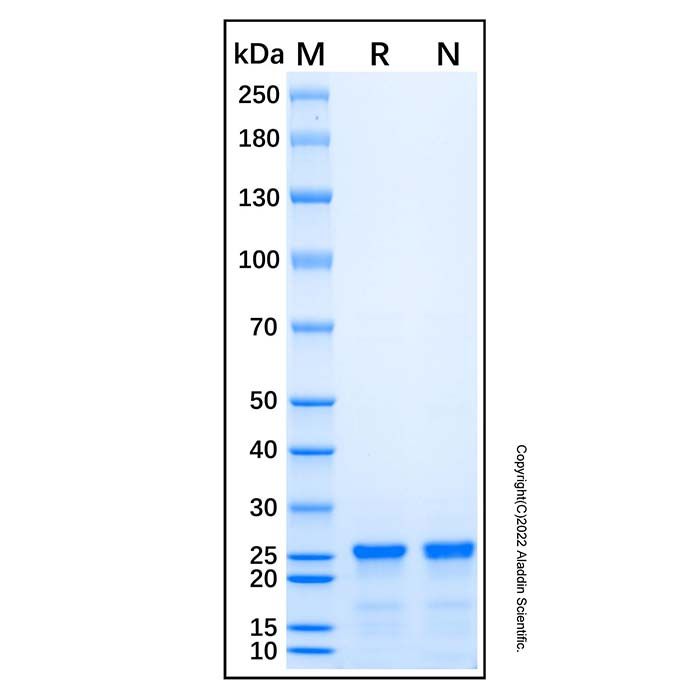
Recombinant Human ALK/CD246 Protein (rp217142) - SDS-PAGE 3 μg/lane of Recombinant Human ALK/CD246 Protein was resolved with SDS-PAGE under reducing (R) and non-reducing (N) conditions and visualized by Coomassie® Blue staining, showing a band at 25.6 kDa.

 ZJ25F0926527


 危险品化学品经营许可证(带存储)