AT like disease | Ataxia telangiectasia disorder like | ATLD | DNA recombination and repair protein | Double strand break repair protein MRE11A | Double-strand break repair protein MRE11A | endo/exonuclease Mre11 | HNGS1 | meiotic recombination (S. cerevi
规格或纯度
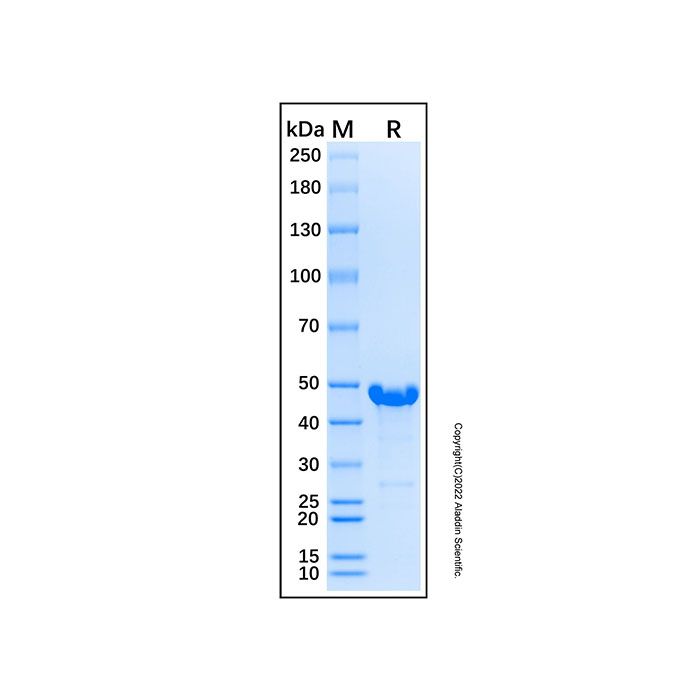
无载体,His标签,≥90%(SDS-PAGE),见COA
生化机理
Component of the MRN complex, which plays a central role in double-strand break (DSB) repair, DNA recombination, maintenance of telomere integrity and meiosis. The complex possesses single-strand endonuclease activity and double-strand-specific 3'-5' exonuclease activity, which are provided by MRE11A. RAD50 may be required to bind DNA ends and hold them in close proximity. This could facilitate searches for short or long regions of sequence homology in the recombining DNA templates, and may also stimulate the activity of DNA ligases and/or restrict the nuclease activity of MRE11A to prevent nucleolytic degradation past a given point. The complex may also be required for DNA damage signaling via activation of the ATM kinase. In telomeres the MRN complex may modulate t-loop formation.
Post-translational: Phosphorylated by ATM at Ser-676 and Ser-678 in response to DNA damage, promoting MRE11 activity: phosphorylation activates MRE11 by preventing the interaction between MRE11 and the C1QBP inhibitor (PubMed:16601701, PubMed:26240375, PubMed:31353207). Phosphorylation at Ser-649 by PLK1 primes for phosphorylation at Ser-688 by CK2, inhibiting recruitment of the MRN complex to DNA damage sites (PubMed:28512243). Asymmetric dimethylation by PRMT1 promotes MRE11 exonuclease activity. Lactylation at Lys-673 by CREBBP/CBP in response to DNA damage promotes DNA binding and MRE11 activity. Acetylated on lysine residues by KAT2A /GCN5. Ubiquitinated following DNA damage (PubMed:30612738). Ubiquitination triggers interaction with UBQLN4, leading to MRE11 removal from chromatin and degradation by the proteasome (PubMed:30612738).
Ubiquitinated at Lys-339 and Lys-480 by RNF126 via 'Lys-27'- and 'Lys-29'-linked polyubiquitin chains, promoting the exonuclease activity of MRE11 (PubMed:36563124).2 publications. SUMOylated by PIAS1, stabilizing MRE11 on chromatin during end resection (PubMed:36050397). DeSUMOylated by SENP3 following removal from DNA double-strand breaks (DSBs) (PubMed:36050397). Ufmylation at Lys-282 promotes MRE11 activity and is required for activation of the ATM and ATR kinases by the MRN complex. (Microbial infection) Following infection by adenovirus E4, ubiquitinated and degraded by a SCF-like E3 ubiquitin ligase complex containing viral proteins E1B-55K and E4-ORF6.
Lyophilized from 20mM Tris, 500mM NaCl, 8M Urea, pH 8.0.
浓度
见COA
复溶
We recommend that this vial be briefly centrifuged prior to opening to bring the contents to the bottom. Reconstitute at 1.0 mg/mL in sterile distilled water. Stock solutions should be apportioned into working aliquots and stored at ≤ -20 °C. Further dilutions should be made in appropriate buffered solutions.
储存条件
-20°C储存,避免反复冻融
运输条件
超低温运输
稳定性与储存
Store at -20℃ for 12 months. Upon reconstitution, it is recommended to aliquot. Avoid freeze/thaw cycle.
图片
Recombinant Human Mre11 Protein (rp217165) - SDS-PAGE 3 μg/lane of Recombinant Human Mre11 Protein was resolved with SDS-PAGE under reducing (R) and visualized by Coomassie® Blue staining, showing a band at 45.8 kDa under reducing conditions.

 ZJ25F0724343


 危险品化学品经营许可证(带存储)