Non-receptor tyrosine kinase involved in various processes such as cell cycle progression, apoptosis, mitotic recombination, genetic instability and histone modifications. In the cytoplasm, plays a pivotal role in signal transduction via its association with cytokine receptors, which constitutes an initiating step in signaling for many members of the cytokine receptor superfamily including the receptors for growth hormone (GHR), prolactin (PRLR), leptin (LEPR), erythropoietin (EPOR), granulocyte-macrophage colony-stimulating factor (CSF2), thrombopoietin (THPO) and multiple interleukins. Following stimulation with erythropoietin (EPO) during erythropoiesis, it is autophosphorylated and activated, leading to its association with erythropoietin receptor (EPOR) and tyrosine phosphorylation of residues in the EPOR cytoplasmic domain. Also involved in promoting the localization of EPOR to the plasma membrane. Also acts downstream of some G-protein coupled receptors. Plays a role in the control of body weight (By similarity). Mediates angiotensin-2-induced ARHGEF1 phosphorylation. In the nucleus, plays a key role in chromatin by specifically mediating phosphorylation of 'Tyr-41' of histone H3 (H3Y41ph), a specific tag that promotes exclusion of CBX5 (HP1 alpha) from chromatin.
Post-translational: Autophosphorylated, leading to regulate its activity. Leptin promotes phosphorylation on tyrosine residues, including phosphorylation on Tyr-813 (By similarity). Autophosphorylation on Tyr-119 in response to EPO down-regulates its kinase activity (By similarity). Autophosphorylation on Tyr-868, Tyr-966 and Tyr-972 in response to growth hormone (GH) are required for maximal kinase activity (By similarity). Also phosphorylated by TEC (By similarity). Phosphorylated on tyrosine residues in response to interferon gamma signaling (PubMed:7615558, PubMed:7673114). Phosphorylated on tyrosine residues in response to a signaling cascade that is activated by increased cellular retinol (PubMed:21368206).Undergoes Notch-induced ubiquitination and subsequent proteasomal degradation which is mediated by ASB1 or ASB2, the substrate-recognition components of probable ECS E3 ubiquitin-protein ligase complexes.
Store at -20℃ for 12 months. Upon receipt, it is recommended to aliquot. Avoid freeze/thaw cycle.
图片
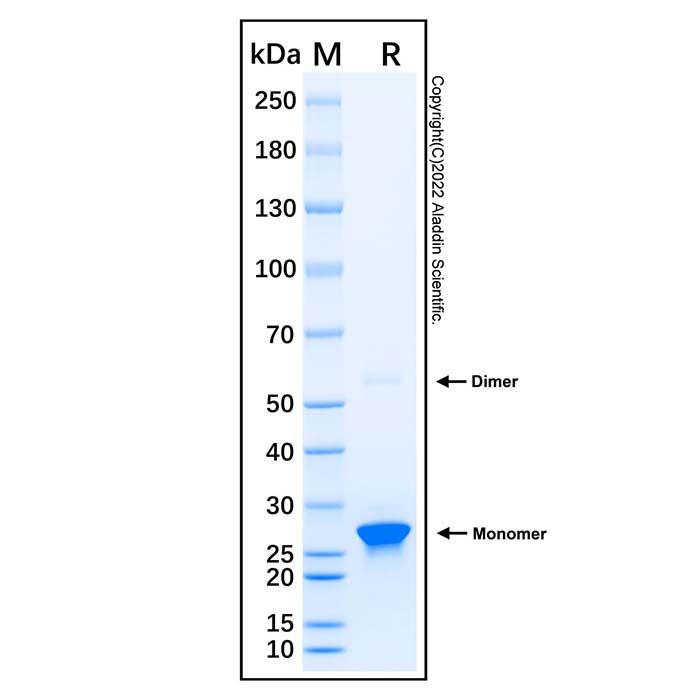
Recombinant Human JAK2 Protein (rp217596) - SDS-PAGE 3 μg/lane of Recombinant Human JAK2 Protein was resolved with SDS-PAGE under reducing (R) conditions and visualized by Coomassie® Blue staining, showing a band at 27.0 & 57.2 kDa under reducing conditions. JAK2 is a non-receptor tyrosine kinase. The kinase domain of this protein exhibits a propensity to form dimers or higher-order polymers, a characteristic that constitutes an integral part of its activation mechanism (PMID: 29379470).

 ZJ25F0927513


 危险品化学品经营许可证(带存储)