CVID10 | DNA binding factor KBF2 | H2TF1 | Lymphocyte translocation chromosome 10 protein | LYT 10 | NF kB2 | NFKB p52/p100 subunit | Nuclear factor Kappa B subunit 2 | Nuclear factor of kappa light polypeptide gene enhancer in B cells 2 | Nuclear factor
规格或纯度
无载体,His标签,≥90%(SDS-PAGE),见COA
生化机理
NFKB2 encodes the p100/p52 protein, a critical mediator of the canonical and noncanonical NFkB signaling pathways. NFKB2 is a member of the NFKB/Rel gene family, which is known to be a pivotal regulator of the acute phase and immune responses. NF-kappaB2 is initially synthesized as a approximately 100 000 Mr protein which needs to be processed in order to bind DNA, either as homodimer or as heterodimer with other members of the NF-kappaB/Rel family. NFKB2 is ubiquitously expressed, highest in lymph nodes and thymus, underlining its role in the immune function.
Post-translational: While translation occurs, the particular unfolded structure after the GRR repeat promotes the generation of p52 making it an acceptable substrate for the proteasome. This process is known as cotranslational processing. The processed form is active and the unprocessed form acts as an inhibitor (I kappa B-like), being able to form cytosolic complexes with NF-kappa B, trapping it in the cytoplasm. Complete folding of the region downstream of the GRR repeat precludes processing.Subsequent to MAP3K14-dependent serine phosphorylation, p100 polyubiquitination occurs then triggering its proteasome-dependent processing.Constitutive processing is tightly suppressed by its C-terminal processing inhibitory domain, named PID, which contains the death domain.Ubiquitinated by TRIM55; leading to processing by VCP and subsequent ubiquitin-dependent protein degradation by the proteasome.
Store at -20℃ for 6 months. Upon receipt, it is recommended to aliquot. Avoid freeze/thaw cycle.
图片
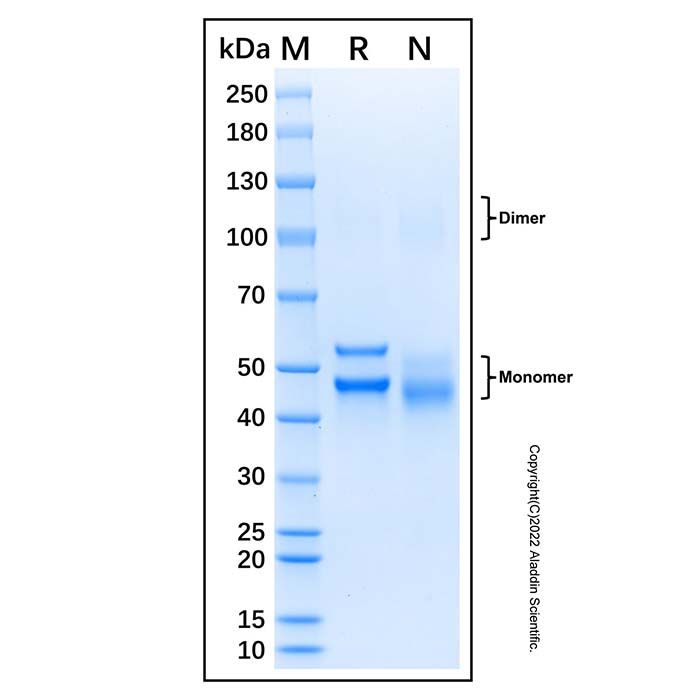
Recombinant Human NFKB2 Protein (rp217598) - SDS-PAGE 3 μg/lane of Recombinant Human NFKB2 Protein was resolved with SDS-PAGE under reducing (R) and non-reducing (N) conditions and visualized by Coomassie® Blue staining, showing a band at 46.6 & 54.5 kDa under reducing conditions and 45.2 & 51.2 & 103.6 kDa under non-reducing conditions. NFKB2 contains RHD (1-400) and partially retained ANK domains (401-447), which triggers the formation of two conformations and dimerization of the RHD domains (1-400) of NFKB2 (PMID: 10597218; PMID: 18267068).



 危险品化学品经营许可证(带存储)