ATG7, also known as APG7, is a 78 kDa cytosolic ubiquitin-E1-like enzyme that plays a key role in the autophagic pathway of intracellular bulk degradation. It is required for the conjugation of ATG5 to ATG12, the lipidation of ATG8, and subsequent autophagosome formation. ATG7 is required for mitochondrial removal during erythropoiesis and for the maintenance of axonal homeostasis. Alternate splicing of human ATG7 generates an isoform that lacks 31 aa at the C-terminus, a region that is required for ATG8 lipidation. Human ATG7 shares 93% aa sequence identitiy with mouse and rat ATG7.
Post-translational: Acetylated by EP300.Polyubiquitinated on Lys-45 via 'Lys-63'-linked ubiquitin by TRIM32; this modification positiely regulates ATG8 and ATG12 activating enzyme activity leading to initiation of autophagy under metabolic stress.
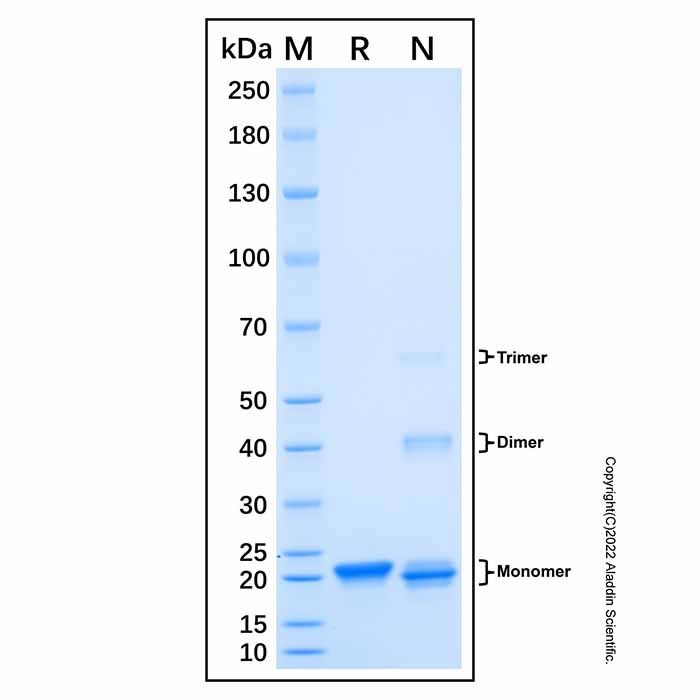
21.5 kDa, under reducing conditions; 20.6 & 41.7 & 61.2 kDa, under non-reducing conditions.
分子类型
蛋白质
产品线
生物产品
储存与运输
物理形态
冻干(Lyophilized)
储存缓冲液
Lyophilized from 20mM Tris, 500mM NaCl, 8M Urea, 90 mM Imidazole, pH 8.0
浓度
见COA
复溶
We recommend that this vial be briefly centrifuged prior to opening to bring the contents to the bottom. Reconstitute at 1.0 mg/mL in sterile distilled water. Stock solutions should be apportioned into working aliquots and stored at ≤ -20 °C. Further dilutions should be made in appropriate buffered solutions.
储存条件
-20°C储存,避免反复冻融
运输条件
超低温运输
稳定性与储存
-20℃保存 6个月;复溶后建议分装,避免反复冻融。
图片
Recombinant Human ATG7 Protein (rp218434) - SDS-PAGE 2 μg/lane of Recombinant Human ATG7 Protein was resolved with SDS-PAGE under reducing (R) and non-reducing (N) conditions and visualized by Coomassie® Blue staining, showing a band at 21.5 kDa under reducing conditions and 20.6 & 41.7 & 61.2 kDa under non-reducing conditions. ATG7 can form Homodimer. The three conformations under non-reducing conditions may correspond to distinct catalytic stages: adenylylation, substrate transfer, and thioester bond formation (Uniprot: O95352).



 危险品化学品经营许可证(带存储)