IRF7 encodes interferon regulatory factor 7, a member of the interferon regulatory transcription factor (IRF) family. IRF7 has been shown to play a role in the transcriptional activation of virus-inducible cellular genes, including interferon beta chain genes. Inducible expression of IRF7 is largely restricted to lymphoid tissue. Multiple IRF7 transcript variants have been identified, although the functional consequences of these have not yet been established.
Post-translational: Acetylation inhibits its DNA-binding ability and activity.In response to a viral infection, phosphorylated on Ser-477 and Ser-479 by TBK1 and IKBKE1. Phosphorylation, and subsequent activation is inhibited by vaccinia virus protein E3. In TLR7- and TLR9-mediated signaling pathway, phosphorylated by IRAK1.TRAF6-mediated ubiquitination is required for IRF7 activation (By similarity). TRIM35 mediates IRF7 'Lys-48'-linked polyubiquitination and subsequent proteasomal degradation (PubMed:25907537). Ubiquitinated by UBE3C, leading to its degradation (PubMed:21167755).Sumoylated by TRIM28, which inhibits its transactivation activity.(Microbial infection) Cleaved and inactivated by the protease 3C of enterovirus 71 allowing the virus to disrupt the host type I interferon production.(Microbial infection) Cleaved and inactivated by the protease 3C of human enterovirus 68D (EV68) allowing the virus to disrupt the host type I interferon production.'Lys-48'-linked polyubiquitination and subsequent proteasomal degradation is NMI-dependent in response to Sendai virus infection.'Lys-63'-linked ubiquitination by NEURL3 promotes IRF7 activation.
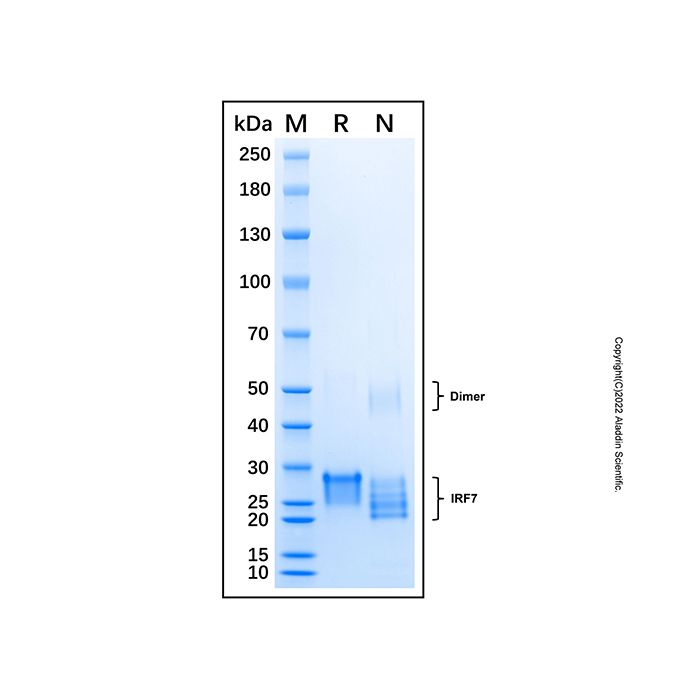
Recombinant Human IRF7 Protein (rp220386) - SDS-PAGE 3 μg/lane of Recombinant Human IRF7 Protein was resolved with SDS-PAGE under reducing (R) and non-reducing (N) conditions and visualized by Coomassie® Blue staining, showing a band at 25.1-28.4 kDa under reducing conditions and 21.5-27.8 & 43.6-51.9 kDa under non-reducing conditions. IRF7 is activated by phosphorylation, leading to dimerization, and may exist in multiple conformations in SDS-PAGE (PMID:17574024).

 ZJ25F0826246


 危险品化学品经营许可证(带存储)