A cytochrome P450 monooxygenase with a key role in vitamin D catabolism and calcium homeostasis. Via C24- and C23-oxidation pathways, catalyzes the inactivation of both the vitamin D precursor calcidiol (25-hydroxyvitamin D3) and the active hormone calcitriol (1-alpha,25-dihydroxyvitamin D3) (PubMed:11012668, PubMed:15574355, PubMed:16617161, PubMed:24893882, PubMed:29461981, PubMed:8679605). With initial hydroxylation at C-24 (via C24-oxidation pathway), performs a sequential 6-step oxidation of calcitriol leading to the formation of the biliary metabolite calcitroic acid (PubMed:15574355, PubMed:24893882). With initial hydroxylation at C-23 (via C23-oxidation pathway), catalyzes sequential oxidation of calcidiol leading to the formation of 25(OH)D3-26,23-lactone as end product (PubMed:11012668, PubMed:8679605). Preferentially hydroxylates at C-25 other vitamin D active metabolites, such as CYP11A1-derived secosteroids 20S-hydroxycholecalciferol and 20S,23-dihydroxycholecalciferol (PubMed:25727742). Mechanistically, uses molecular oxygen inserting one oxygen atom into a substrate, and reducing the second into a water molecule, with two electrons provided by NADPH via FDXR/adrenodoxin reductase and FDX1/adrenodoxin (PubMed:8679605).
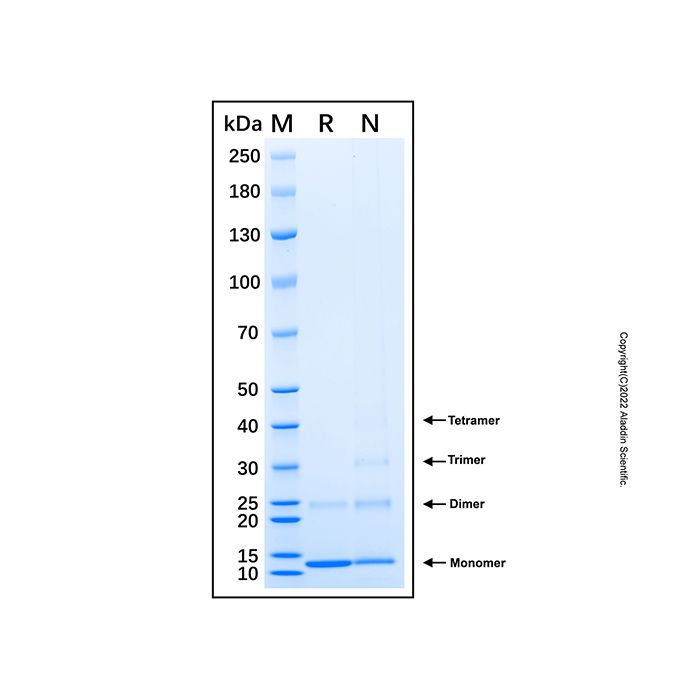
Recombinant Human CYP24A1 Protein (rp220434) - SDS-PAGE 3 μg/lane of Recombinant Human CYP24A1 Protein was resolved with SDS-PAGE under reducing (R) and non-reducing (N) conditions and visualized by Coomassie® Blue staining, showing a band at 12.5 & 24.5 kDa under reducing conditions and 15.1 & 25.1 & 31.1 & 41.5 kDa under non-reducing conditions. Under specific non-physiological conditions, including high concentrations or particular buffer environments, CYP24A1 monomers have the potential to form non-covalent dimers or higher-order oligomers through non-covalent interactions (Uniprot ID: Q07973).

 ZJ25F0826342


 危险品化学品经营许可证(带存储)