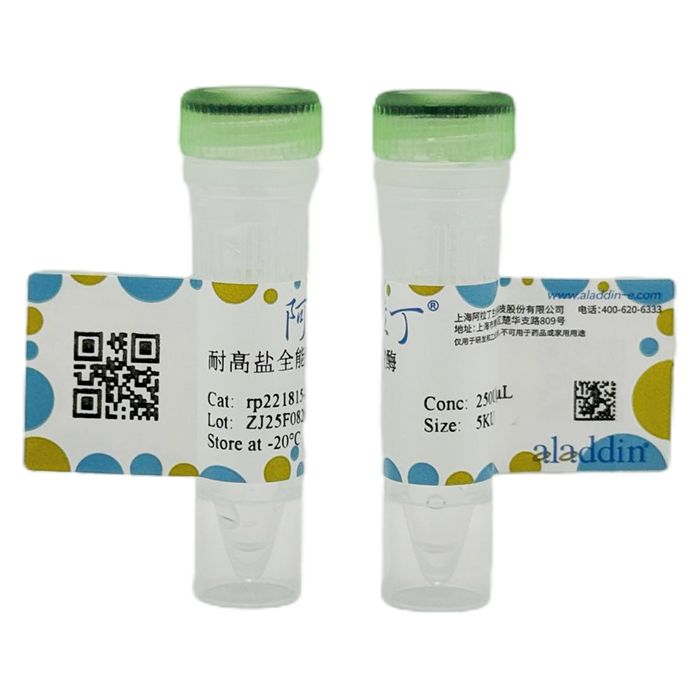
本公司生产的耐高盐全能核酸酶即Salt Active UltraNuclease 是一种来源于海洋微生物的重组非特异性核酸内切酶,与UltraNuclease 相比在 0.5M NaCl 条件下具有最佳活性,广泛应用于生产工艺流程中,有效去除核酸污染。本品经基因工程改造在 Escherichia coli(E. coli)中表达纯化,不仅可在科学研究中降低细胞上清和细胞裂解液的粘度,提高蛋白纯化效率及功能研究;还可以应用在病毒纯化、疫苗生产、蛋白和多糖类制药工业作为宿主残留核酸去除试剂,将宿主残留核酸降至皮克(pg)级别从而提高生物制品功效和安全性;并且可以有效防止细胞治疗和疫苗研究中人外周血单核细胞(PBMC)的结团。本品以无菌液体酶的形式提供,储存于缓冲液(25 mM Tris-HCl, 5 mM MgCl₂, 500 mMNaCl, 50% Glycerol, pH 7.5)中,无色透明液体。
| 来源(Source) | 大肠杆菌重组表达 |
| 分子量(Molecular Weight) | 24.7 kDa |
| 外观(Appearance) | 无菌液体 |
| 保存液(Storage Buffer) | 25 mM Tris-HCl,5 mM MgCl₂,500 mM NaCl,50% Glycerol,pH 7.5 |
| 酶浓度(Enzyme Concentration) | 250U/μL |
| 辅助因子(Cofactor) | 1-10 mM Mg²⁺ |
| 纯度(Purity) | ≥99% |
| 活性定义(Activity Definition) | 一定条件下,在底物过量时 37℃ ,30 min 内 260 nm 处吸光值变化 1.0 所需要的酶量定义为一个活性单位(U)。 |
产品应用
降解双链和单链 DNA 和 RNA、线性和环状 DNA 和 RNA 以及 DNA:RNA 杂交链产品,去除蛋白质、病毒或小分子纯化生物工艺流程各个步骤中的核酸(DNA 和 RNA);在生产病毒载体(例如 AAV)的细胞裂解过程中进行核酸酶处理,清除裂解物中的核酸(DNA 和 RNA),改善蛋白质与亲和性树脂的结合或降低背压。
优势
反应可放大并与高通量实验流程兼容,未糖基化、重组表达、不含洗涤剂。可通过阳离子交换树脂轻松地从反应体系中去除。
使用说明
1、样本准备
贴壁细胞:去除培养基,用 PBS 清洗细胞,去除上清。
悬浮细胞:离心收集细胞,用 PBS 清洗细胞,6,000 rpm 离心 10 min,收集沉淀。
大肠杆菌:离心收集菌体,用 PBS 清洗 1 次,8,000 rpm 离心 5 min,收集沉淀。
2、样品处理
将收集到的细胞沉淀按照质量(g)与体积(mL)比 1:(10~20) 的比例进行裂解处理,也可通过在冰上或室温通过机械或化学方法裂解细胞(1 g 细胞约为 109 个)。
3、酶的添加
1. 添加适量 MgCl₂ 将反应体系中的 Mg²⁺ 浓度调整在 1-5 mM 范围内,将 pH 调整成 7.5-9。
2.按照 250 Units 消化 1 g 细胞沉淀的比例添加 Salt Active UltraNuclease,37℃孵育 30min 以上。也可以自行选定添加方案,在一定范围内增加酶量,消化所需时间相应减少。
【注】耐高盐全能核酸酶的酶活受离子浓度、反应温度及 pH 等因素的影响,初次使用时建议摸索最适浓度。
4、上清获取
以 12,000 rpm 的转速离心 30min 获得细胞裂解液上清,再进行后续相关实验。
【注】若溶液偏酸性或者偏碱性,含有较高浓度的去垢剂、变性剂,应适当增加酶的用量或延长孵育时间。
保存条件:-20℃保存,≤0℃运输。
注意事项:
(1)本产品仅限于专业人员的科学研究用,不得用于临床诊断或治疗,不得用于食品或药品,不得存放于普通住宅内。
(2)为了您的安全和健康,请穿实验服并戴一次性手套操作。
Salt Active UltraNuclease, the high‑salt‑tolerant universal nuclease produced by our company, is a recombinant non‑specific endonuclease derived from marine microorganisms. Compared with UltraNuclease, it exhibits optimal activity under 0.5 M NaCl condition. It is widely used in manufacturing processes for efficient removal of nucleic acid contamination.
This product is genetically engineered and expressed and purified in Escherichia coli (E. coli). In research applications, it can reduce the viscosity of cell supernatants and cell lysates, and improve protein purification efficiency for functional studies. It can also be applied in virus purification, vaccine manufacturing, as well as protein‑ and polysaccharide‑based pharmaceutical industries as a reagent for removing host residual nucleic acids. It can reduce host residual nucleic acids to the picogram (pg) level, so as to improve the efficacy and safety of biological products. Furthermore, it effectively prevents aggregation of human peripheral blood mononuclear cells (PBMCs) in cell‑therapy and vaccine research.
This product is supplied as a sterile liquid enzyme stored in buffer (25 mM Tris‑HCl, 5 mM MgCl₂, 500 mM NaCl, 50% Glycerol, pH 7.5), and appears as a colorless transparent liquid.
| Source | Recombinant expression in Escherichia coli | | Molecular Weight | 24.7 kDa | | Appearance | Sterile liquid | | Storage Buffer | 25 mM Tris‑HCl, 5 mM MgCl₂, 500 mM NaCl, 50% Glycerol, pH 7.5 | | Enzyme Concentration | 250 U/μL | | Cofactor | 1‑10 mM Mg²⁺ | | Purity | ≥99% | | Activity Definition | One unit (U) is defined as the amount of enzyme required to produce an absorbance change of 1.0 at 260 nm within 30 min at 37 °C under substrate‑excess conditions. |
|
Product Applications
Degrades double‑stranded and single‑stranded DNA and RNA, linear and circular DNA and RNA, as well as DNA:RNA hybrid strands. Removes nucleic acids (DNA and RNA) at each step of biological workflows for purification of proteins, viruses or small molecules. Perform nuclease treatment during cell lysis for viral vector (e.g., AAV) production to eliminate nucleic acids (DNA and RNA) in lysates, improve protein binding to affinity resins or reduce back‑pressure.
Advantages
Scalable reactions, compatible with high‑throughput workflows. Non‑glycosylated, recombinantly expressed, detergent‑free. Can be readily removed from reaction mixtures via cation‑exchange resin.
Instructions for Use
1. Sample Preparation
Adherent cells: Remove medium, wash cells with PBS and discard supernatant.
Suspension cells: Harvest cells by centrifugation, wash with PBS, centrifuge at 6,000 rpm for 10 min and collect pellet.
E. coli: Harvest bacterial cells by centrifugation, wash once with PBS, centrifuge at 8,000 rpm for 5 min and collect pellet.
2. Sample Lysis
Lyse the collected cell pellet at a mass‑to‑volume ratio of 1 g : (10‑20) mL. Cells may be lysed mechanically or chemically on ice or at room temperature (1 g of cells ≈ 10⁹ cells).
3. Enzyme Addition
①Adjust Mg²⁺ concentration in the reaction system to 1‑5 mM with appropriate amount of MgCl₂, and adjust pH to 7.5‑9.
②Add Salt Active UltraNuclease at the dosage of 250 Units per 1 g cell pellet, and incubate at 37 °C for no less than 30 min. Alternative dosing schemes are acceptable; increasing enzyme dosage within a reasonable range shortens digestion time.
Note: The enzymatic activity of Salt Active UltraNuclease is affected by ionic strength, reaction temperature and pH. It is recommended to optimize working concentration upon first‑time use.
4. Supernatant Collection
Centrifuge at 12,000 rpm for 30 min to obtain the clarified cell lysate supernatant for subsequent experiments.
Note: If the solution is strongly acidic/alkaline or contains high concentrations of detergents or denaturants, appropriately increase enzyme dosage or prolong incubation time.
Storage Condition: Store at −20 °C; transport at ≤0 °C.
Precautions:
1. This product is for research‑only use by qualified professionals. Not for clinical diagnosis or therapy, not for food or pharmaceutical applications. Do not store in residential premises.
2. For personal safety and health, wear laboratory coat and disposable gloves during operation.

 ZJ26F0535911


 危险品化学品经营许可证(带存储)