TSG101 is a member of apparently inactive homologs of ubiquitin-conjugating enzymes. TSG101 contains a coiled-coil domain that interacts with stathmin, a cytosolic phosphoprotein implicated in tumorigenesis. TSG101 is involved in cell growth and differentiation and acts as a negative growth regulator. TSG101 in vitro steady-state expression is important for maintenance of genomic stability and cell cycle regulation. TSG101 mutations and alternative splicing occur in high rate in breast cancer and implicate that defects occur during breast cancer tumorigenesis and/or progression. TSG101 is a factor of the ESCRT-I complex, a monitor of vesicular trafficking process. TSG101 binds to ubiquitinated cargo proteins and is needed for the sorting of endocytic ubiquitinated cargos into multivesicular bodies. TSG101 is needed for completion of cytokinesis and is involved in cell growth and differentiation.
Post-translational: Monoubiquitinated at multiple sites by LRSAM1 and by MGRN1. Ubiquitination inactivates it, possibly by regulating its shuttling between an active membrane-bound protein and an inactive soluble form. Ubiquitination by MGRN1 requires the presence of UBE2D1.
Store at -20℃ for 12 months. Upon receipt, it is recommended to aliquot. Avoid freeze/thaw cycle.
图片
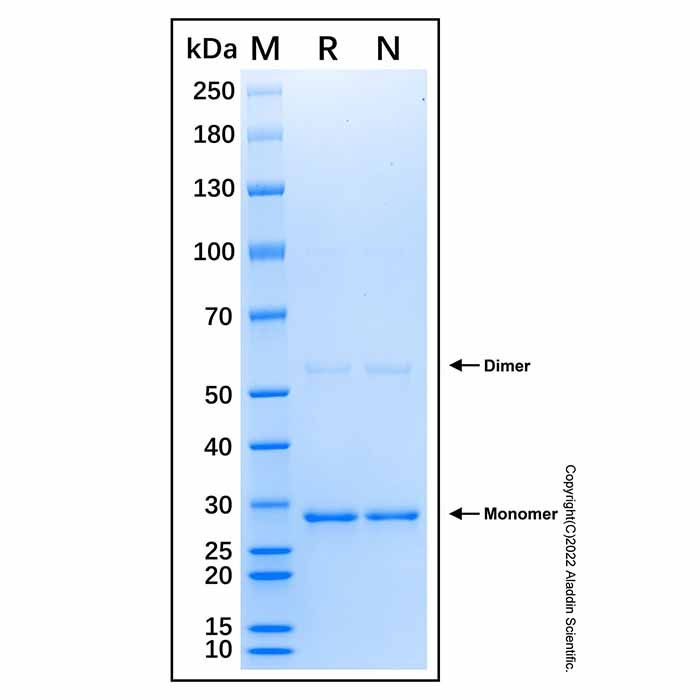
Recombinant Human Tsg101 Protein (rp223221) - SDS-PAGE 3 μg/lane of Recombinant Human Tsg101 Protein was resolved with SDS-PAGE under reducing (R) and non-reducing (N) conditions and visualized by Coomassie® Blue staining, showing a band at 28.5 & 55.3 kDa. Our purified Tsg101 protein preparations contain low levels of dimers and oligomers, which may be attributed to the protein's extensive interactions with other proteins (Uniprot: Q99816).

 ZJ25F0622945


 危险品化学品经营许可证(带存储)