beta-Catenin, also known as CTNNB1, is a member of the armadillo family of proteins. These proteins have multiple copies of the so-called armadillo repeat domain, which is specialized for protein-protein binding. It is part of a complex of proteins that constitute adherens junctions (AJs). AJs are necessary for the creation and maintenance of epithelial cell layers by regulating cell growth and adhesion between cells. CTNNB1 also anchors the actin cytoskeleton and may be responsible for transmitting the contact inhibition signal that causes cells to stop dividing once the epithelial sheet is complete. Finally, beta-Catenin binds to the product of the APC gene, which is mutated in adenomatous polyposis of the colon. Defects in beta-Catenin can cause colorectal cancer, pilomatrixoma (PTR), medulloblastoma, and ovarian cancer. CTNNB1 is a key dowstream component of the canonical Wnt signaling pathway. In the absence of Wnt, it forms a complex with AXIN1, AXIN2, APC, CSNK1A1 and GSK3B that promotes phosphorylation on N-terminal Ser and Thr residues and ubiquitination of CTNNB1 via BTRC and its subsequent degradation by the proteasome. In the presence of Wnt ligand, beta-Catenin is not ubiquitinated and accumulates in the nucleus, where it acts as a coactivator for transcription factors of the TCF/LEF family, leading to activate Wnt responsive genes. CTNNB1 is involved in the regulation of cell adhesion. The majority of beta-catenin is localized to the cell membrane and is part of E-cadherin/catenin adhesion complexes which are proposed to couple cadherins to the actin cytoskeleton.
Post-translational: Phosphorylation at Ser-552 by AMPK promotes stabilization of the protein, enhancing TCF/LEF-mediated transcription (By similarity). Phosphorylation by GSK3B requires prior phosphorylation of Ser-45 by another kinase (PubMed:10966653, PubMed:12027456, PubMed:12051714). Phosphorylation proceeds then from Thr-41 to Ser-37 and Ser-33 (PubMed:12077367, PubMed:25169422). Phosphorylated by NEK2 (PubMed:18086858). EGF stimulates tyrosine phosphorylation (PubMed:10187801). Phosphorylated on Ser-33 and Ser-37 by HIPK2 and GSK3B, this phosphorylation triggers proteasomal degradation (PubMed:20307497). Phosphorylation on Ser-191 and Ser-246 by CDK5 (PubMed:17009320). Phosphorylation by CDK2 regulates insulin internalization (PubMed:21262353). Phosphorylation by PTK6 at Tyr-64, Tyr-142, Tyr-331 and/or Tyr-333 with the predominant site at Tyr-64 is not essential for inhibition of transcriptional activity (PubMed:20026641). Phosphorylation by SRC at Tyr-333 promotes interaction with isoform M2 of PKM (PKM2); promoting transcription activation (PubMed:22056988). Ubiquitinated by the SCF(BTRC) E3 ligase complex when phosphorylated by GSK3B, leading to its degradation (PubMed:12077367). Ubiquitinated by a E3 ubiquitin ligase complex containing UBE2D1, SIAH1, CACYBP/SIP, SKP1, APC and TBL1X, leading to its subsequent proteasomal degradation (PubMed:11389839, PubMed:11389840, PubMed:20307497). Ubiquitinated and degraded following interaction with SOX9 (By similarity). Ubiquitinated via 'Lys-11'- and 'Lys-29'-linked ubiquitin chains by UBR5, leading to its stabilization (PubMed:21118991). S-nitrosylation at Cys-619 within adherens junctions promotes VEGF-induced, NO-dependent endothelial cell permeability by disrupting interaction with E-cadherin, thus mediating disassembly adherens junctions. O-glycosylation at Ser-23 decreases nuclear localization and transcriptional activity, and increases localization to the plasma membrane and interaction with E-cadherin CDH1. Deacetylated at Lys-49 by SIRT1. Phosphorylated at Thr-556 by herpes virus 1/HHV-1 leading to CTNNB1 inhibition.
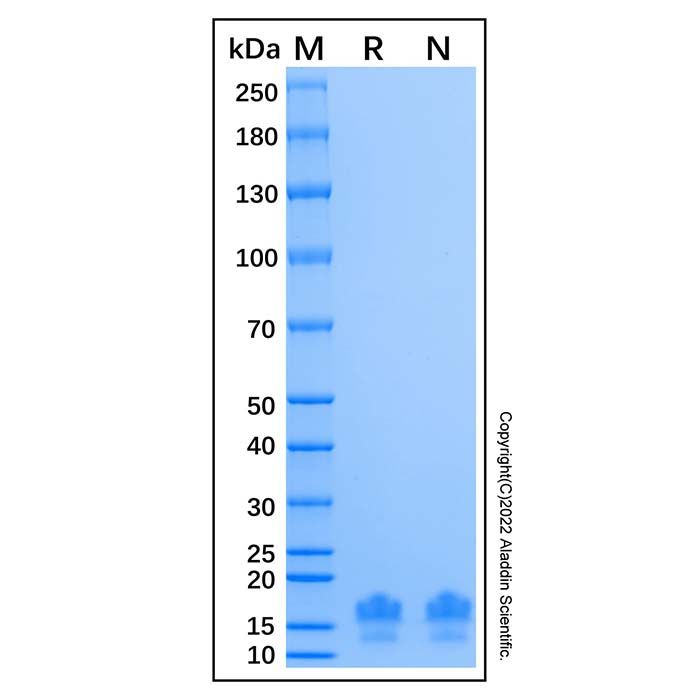
16.1 kDa, under reducing conditions; 16.7 kDa, under non-reducing conditions.
分子类型
蛋白质
产品线
生物产品
储存与运输
物理形态
冻干(Lyophilized)
储存缓冲液
Lyophilized from PBS, pH 7.4.
浓度
见COA
复溶
We recommend that this vial be briefly centrifuged prior to opening to bring the contents to the bottom. Reconstitute at 1.0 mg/mL in sterile distilled water. Stock solutions should be apportioned into working aliquots and stored at ≤ -20 °C. Further dilutions should be made in appropriate buffered solutions.
储存条件
-20°C储存,避免反复冻融
运输条件
超低温运输
稳定性与储存
Store at -20℃ for 1 year. Upon reconstitution, it is recommended to aliquot. Avoid freeze/thaw cycle.
图片
Recombinant Human Catenin beta-1 Protein (rp223895) - SDS-PAGE 3 μg/lane of Recombinant Human Catenin beta-1 Protein was resolved with SDS-PAGE under reducing (R) and non-reducing (N) conditions and visualized by Coomassie® Blue staining, showing a band at 16.1 kDa under reducing conditions and 16.7 kDa under non-reducing conditions.

 ZJ25F0622627


 危险品化学品经营许可证(带存储)