Forms a water-specific channel (PubMed : 19383790, PubMed : 7559426, PubMed : 8601457). Plays an important role in brain water homeostasis (PubMed : 37143309). It is involved in glymphatic solute transport and is required for a normal rate of water exchange across the blood brain interface. Required for normal levels of cerebrospinal fluid influx into the brain cortex and parenchyma along paravascular spaces that surround penetrating arteries, and for normal drainage of interstitial fluid along paravenous drainage pathways. Thereby, it is required for normal clearance of solutes from the brain interstitial fluid, including soluble beta-amyloid peptides derived from APP. Plays a redundant role in urinary water homeostasis and urinary concentrating ability (By similarity).
Post-translational: Phosphorylation by PKC at Ser-180 reduces conductance by 50%. Phosphorylation by PKG at Ser-111 in response to glutamate increases conductance by 40% (By similarity). Isoform 2: Palmitoylated on its N-terminal region. Isoform 1: Not palmitoylated
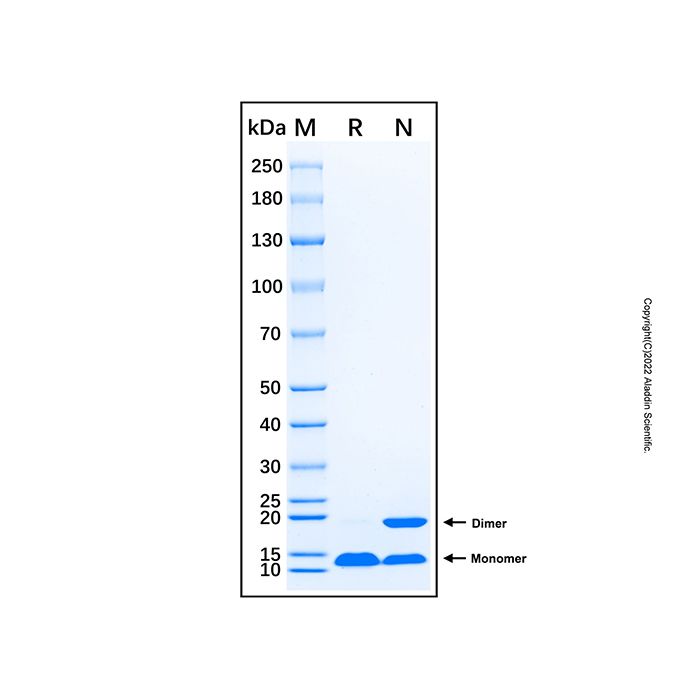
13.2 kDa, under reducing conditions; 13.2 &19.2 kDa, under non-reducing conditions.
分子类型
蛋白质
产品线
生物产品
储存与运输
物理形态
液体
储存缓冲液
PBS, 50% Glycerol, pH 7.4
浓度
expressed in E. coli; 见COA
储存条件
-20°C储存,避免反复冻融
运输条件
超低温运输
稳定性与储存
-20℃ 存储12个月;收货后建议分装,避免反复冻融。
图片
Recombinant Human AQP4 Protein (rp225004) - SDS-PAGE
3 μg/lane of Recombinant Human AQP4 Protein was resolved with SDS-PAGE under reducing (R) and non-reducing (N) conditions and visualized by Coomassie® Blue staining, showing the bands at 13.2 kDa under reducing conditions and 13.2 & 19.2 kDa under non-reducing conditions.
The AQP4 Cys253-Val323 fragment starts with a cysteine residue. The free thiol group of this cysteine is highly reactive and, under oxidizing conditions, readily forms intermolecular disulfide bonds with another thiol group. This covalently cross-links individual protein molecules together, leading to dimer formation (Uniprot ID: P55087).

 ZJ26F0535764


 危险品化学品经营许可证(带存储)