CD19 protein is a ransmembrane glycoprotein that plays a central role in B cell activation and humoral immune responses. CD19 is expressed throughout B cell development from pre-B cells through mature B cells, and it is commonly used as a B cell lineage marker. It is required for the responsiveness of mature B cell to antigen stimulation, germinal center development, and antibody affinity maturation. The CD19 protein associates with the B cell antigen receptor (BCR), CD81, CD38, CD21, CD22, and IFITM1/CD225/Leu13. These associations enable CD19 to amplify B cell signaling and reduce the threshold for antigen stimulation through the BCR. CD19 polymorphisms and up-regulation can lead to the development of autoimmunity by promoting autoantibody production. CD19 has emerged as promising therapeutic target for hematologic cancers and solid tumors. Immunotherapy using a chimeric antigen receptor (CAR) targeting CD19 has proven effective in many different cancers. The first CD19 CAR T cell therapies have been granted FDA approval for the treatment of B cell malignancies with several more in clinical trials.
Mature human CD19 protein consists of a 272 amino acid (aa) extracellular domain (ECD) with two Ig-like domains, a 22 aa transmembrane segment, and a 243 aa cytoplasmic domain. Within the ECD, human CD19 shares 57% amino acid sequence identity with mouse and rat CD19.
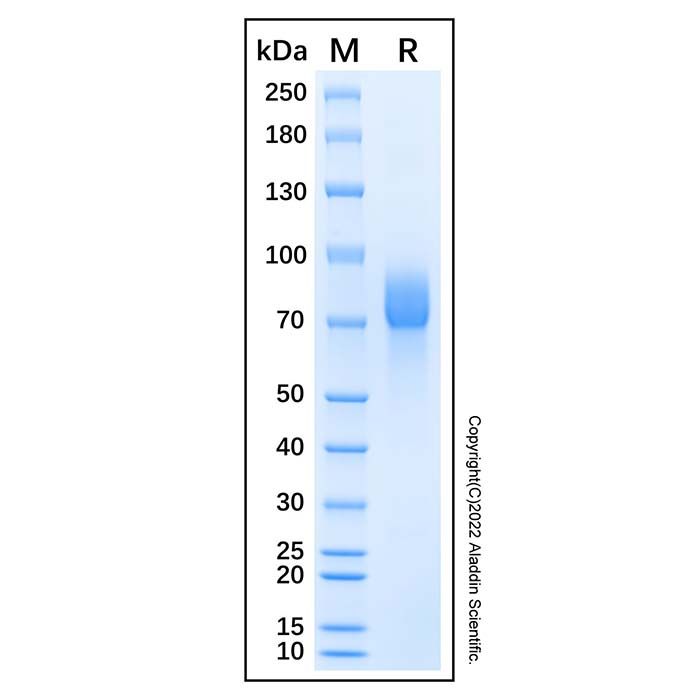
68.1-93.2 kDa, under reducing conditions; XX kDa, under non-reducing conditions.
分子类型
蛋白质
产品线
生物产品
储存与运输
物理形态
冻干(Lyophilized)
储存缓冲液
Lyophilized from PBS, pH 7.4
浓度
见COA
复溶
We recommend that this vial be briefly centrifuged prior to opening to bring the contents to the bottom. Reconstitute at 1.0 mg/mL in sterile distilled water. Stock solutions should be apportioned into working aliquots and stored at ≤ -20 °C. Further dilutions should be made in appropriate buffered solutions.
储存条件
-20°C储存,避免反复冻融
运输条件
超低温运输
稳定性与储存
-20℃保存 12个月;复溶后建议分装,避免反复冻融。
图片
Recombinant Canis lupus CD19 Protein (rp225824) - SDS-PAGE 3 μg/lane of Recombinant Canis lupus CD19 Protein was resolved with SDS-PAGE under reducing (R) and visualized by Coomassie® Blue staining, showing a band at 68.1-93.2 kDa.

 ZJ25F0927635


 危险品化学品经营许可证(带存储)