M-CSF, also known as CSF-1, is a four-alpha-helical-bundle cytokine that is the primary regulator of macrophage survival, proliferation, and differentiation. M-CSF is also essential for the survival and proliferation of osteoclast progenitors. It primes and enhances macrophage killing of tumor cells and microorganisms, regulates the release of cytokines and other inflammatory modulators from macrophages, and stimulates pinocytosis. M-CSF increases during pregnancy to support implantation and growth of the decidua and placenta. Sources of M-CSF include fibroblasts, activated macrophages, endometrial secretory epithelium, bone marrow stromal cells, and activated endothelial cells. The M-CSF receptor (c-fms) transduces its pleotropic effects and mediates its endocytosis. M-CSF mRNAs of various sizes occur. Full-length human M-CSF transcripts encode a 522 amino acid type I transmembrane protein with a 464 amino acid extracellular region, a 21 amino acid transmembrane domain, and a 37 amino acid cytoplasmic tail that forms a 140 kDa covalent dimer. Differential processing produces two proteolytically cleaved, secreted dimers. One is an N- and O-glycosylated 86 kDa dimer, while the other is modified by both glycosylation and chondroitin-sulfate proteoglycan to generate a 200 kDa subunit. Although proteoglycan-modified M-CSF can circulate, it may be immobilized by attachment to type V collagen. Shorter transcripts encode M-CSF that lacks cleavage and proteoglycan sites and produces an N-glycosylated 68 kDa transmembrane dimer and a slowly produced 44 kDa secreted dimer. Although forms may vary in activity and half-life, all contain the N-terminal 150 amino acid portion that is necessary and sufficient for interaction with the M-CSF receptor. The first 223 amino acids of mature human M-CSF share 88%, 86%, 81%, and 74% amino acid identity with corresponding regions of dog, cow, mouse, and rat M-CSF, respectively. Human M-CSF is active in the mouse, but mouse M-CSF is reported to be species-specific.
Post-translational: N-glycosylated. O-glycosylated.
生物活性
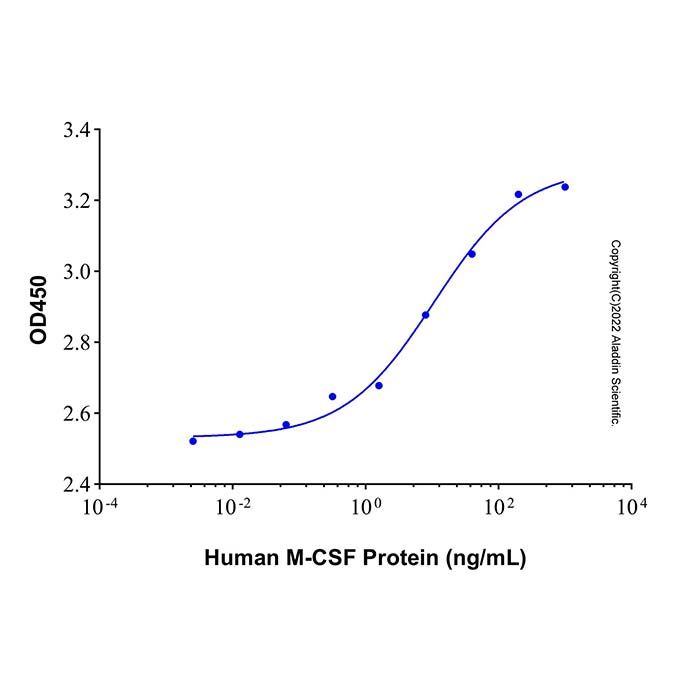
Measured in a cell proliferation assay using M‑NFS‑60 mouse myelogenous leukemia lymphoblast cells. The ED50 for this effect is typically 10.6 ng/mL.
38.0-50.9 kDa, under reducing conditions; 37.6-47.8 & 74.7-101.6 kDa, under non-reducing conditions.
分子类型
蛋白质
产品线
生物产品
储存与运输
物理形态
冻干(Lyophilized)
储存缓冲液
Lyophilized from PBS, pH 7.4
浓度
见COA
复溶
We recommend that this vial be briefly centrifuged prior to opening to bring the contents to the bottom. Reconstitute at 0.5 mg/mL in sterile distilled water. Stock solutions should be apportioned into working aliquots and stored at ≤ -20 °C. Further dilutions should be made in appropriate buffered solutions.
储存条件
-20°C储存,避免反复冻融
运输条件
超低温运输
稳定性与储存
-20℃保存 12个月;复溶后建议分装,避免反复冻融。
图片
Recombinant Human M-CSF Protein (rp228963) - Protein Bioactivity
Measured in a cell proliferation assay using M‑NFS‑60 mouse myelogenous leukemia lymphoblast cells. The ED₅₀ for this effect is typically 10.6 ng/mL.
Recombinant Human M-CSF Protein (rp228963) - SDS-PAGE
2 μg/lane of Recombinant Human M-CSF Protein was resolved with SDS-PAGE under reducing (R) and non-reducing (N) conditions and visualized by Coomassie® Blue staining, showing the bands at 38.0-50.9 kDa under reducing conditions and 37.6-47.8 & 74.7-101.6 kDa under non-reducing conditions.
M-CSF can forms homodimer cause there are cysteine in the sequence (Uniprot: P09603).

 ZJ26F0231951


 危险品化学品经营许可证(带存储)