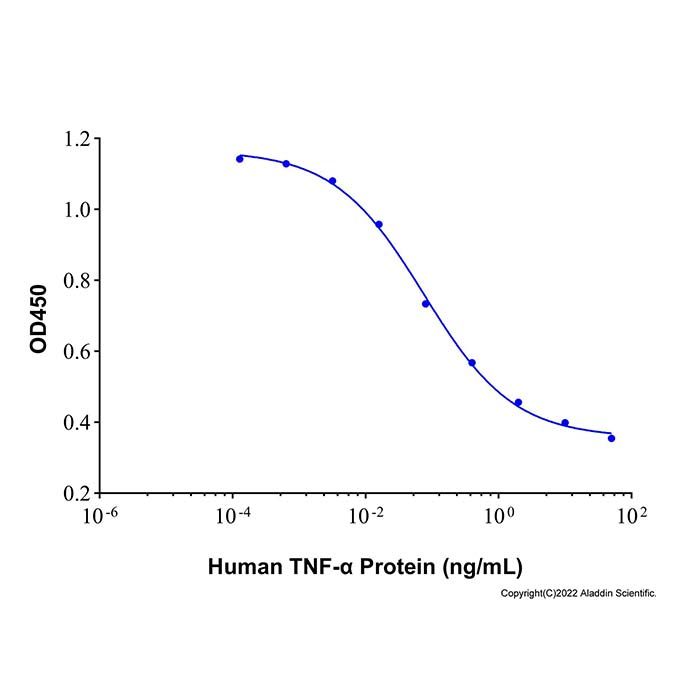
Measured in a cytotoxicity assay using L‑929 mouse fibroblast cells in the presence of the metabolic inhibitor actinomycin D (Catalog # A113142). The ED50 for this effect is typically 0.075 ng/mL.
Tumor necrosis factor alpha (TNF-alpha), also known as cachectin and TNFSF2, is the prototypic ligand of the TNF superfamily. It is a pleiotropic molecule that plays a central role in inflammation, immune system development, apoptosis, and lipid metabolism. Human TNF-alpha consists of a 35 amino acid (aa) cytoplasmic domain, a 21 aa transmembrane segment, and a 177 aa extracellular domain (ECD). Within the ECD, human TNF-alpha shares 97% aa sequence identity with rhesus and 71%-92% with bovine, canine, cotton rat, equine, feline, mouse, porcine, and rat TNF-alpha. TNF-alpha is produced by a wide variety of immune, epithelial, endothelial, and tumor cells. TNF-alpha is assembled intracellularly to form a noncovalently linked homotrimer which is expressed on the cell surface. Cell surface TNF-alpha can induce the lysis of neighboring tumor cells and virus-infected cells, and it can generate its own downstream cell signaling following ligation by soluble TNFR I. Shedding of membrane-bound TNF-alpha by TACE/ADAM17 releases the bioactive cytokine, a 55 kDa soluble trimer of the TNF-alpha extracellular domain. TNF-alpha binds the ubiquitous 55-60 kDa TNF RI and the hematopoietic cell-restricted 80 kDa TNF RII, both of which are also expressed as homotrimers. Both type I and type II receptors bind TNF-alpha with comparable affinity, although only TNF RI contains a cytoplasmic death domain which triggers the activation of apoptosis. Soluble forms of both types of receptors are released and can neutralize the biological activity of TNF-alpha.
Post-translational: The soluble form derives from the membrane form by proteolytic processing. The membrane-bound form is further proteolytically processed by SPPL2A or SPPL2B through regulated intramembrane proteolysis producing TNF intracellular domains (ICD1 and ICD2) released in the cytosol and TNF C-domain 1 and C-domain 2 secreted into the extracellular space. The membrane form, but not the soluble form, is phosphorylated on serine residues. Dephosphorylation of the membrane form occurs by binding to soluble TNFRSF1A/TNFR1. O-glycosylated; glycans contain galactose, N-acetylgalactosamine and N-acetylneuraminic acid. Tumor necrosis factor, soluble form. The soluble form is demyristoylated at Lys-19 and Lys-20 by SIRT6, promoting its secretion.
生物活性
Measured in a cytotoxicity assay using L‑929 mouse fibroblast cells in the presence of the metabolic inhibitor actinomycin D (Catalog # A113142). The ED50 for this effect is typically 0.075 ng/mL.
18.3 kDa, under reducing conditions;18.3 & 36.4 kDa, under non-reducing condition
分子类型
蛋白质
产品线
生物产品
储存与运输
物理形态
冻干(Lyophilized)
储存缓冲液
Lyophilized from PBS, pH 7.4
浓度
见COA
复溶
We recommend that this vial be briefly centrifuged prior to opening to bring the contents to the bottom. Reconstitute at 1.0 mg/mL in sterile distilled water. Stock solutions should be apportioned into working aliquots and stored at ≤ -20 °C. Further dilutions should be made in appropriate buffered solutions.
储存条件
-20°C储存,避免反复冻融
运输条件
超低温运输
稳定性与储存
Store at -20℃ for 12 months. Upon reconstitution, it is recommended to aliquot. Avoid freeze/thaw cycle.
图片
Recombinant Human TNF-α Protein (rp228983) - Protein Bioactivity
Measured in a cytotoxicity assay using L‑929 mouse fibroblast cells in the presence of the metabolic inhibitor actinomycin D (Catalog # A113142). The ED₅₀ for this effect is typically 0.075 ng/mL.
Recombinant Human TNF-α Protein (rp228983) - SDS-PAGE
3 μg/lane of Recombinant Human TNF-α Protein was resolved with SDS-PAGE under reducing (R) and non-reducing (N) conditions and visualized by Coomassie® Blue staining, showing the bands at 18.3 kDa under reducing conditions and 18.3 & 36.4 kDa under non-reducing conditions.
The observation of protein as both dimers and monomers under non-reducing (NR) conditions suggests that a portion of the protein forms dimers. This dimerization may be mediated by (or stabilized by) disulfide bonds (Uniprot: P01375).

 ZJ25F1129665


 危险品化学品经营许可证(带存储)