P-selectin glycoprotein ligand-1 (PSGL-1), also known as SELPLG or CD162, is the high affinity ounter-receptor for P-selectin on expressed on activated endothelial cells and platelets. PSGL-1 is a mucin-type glycoprotein, expressed on leukocytes and platelets as a homodimer of two disulfide-linked subunits of ~12 kD. As cell adhesion molecules, multiple studies have shown that PSGL-1/ P-selectin interaction is required for the normal recruitment of leukocytes during inflammatory reactions, and also participates in hemostatic responses. PSGL-1 protein requires two distinct posttranslational modifications for the Ca2+-dependent recognition by the lectin domain of P-selectin, that is tyrosine sulfation and specific O-linked glycosylation (sialic acid and fucose). PSGL-1 can also bind to other two members of the selectin family, E-selectin (endothelial) and L-selectin (leukocyte), but binds best to P-selectin.
Post-translational: Displays complex, core-2, sialylated and fucosylated O-linked oligosaccharides, at least some of which appear to contain poly-N-acetyllactosamine with varying degrees of substitution. Mainly disialylated or neutral forms of the core-2 tetrasaccharide, Galbeta1-->4GlcNAcbeta1-->6(Galbeta1-->3)GalNAcOH. The GlcN:GalN ratio is approximately 2:1 and the Man:Fuc ratio 3:5. Contains about 14% fucose with alpha-1,3 linkage present in two forms: One species is a disialylated, monofucosylated glycan, and the other, a monosialylated, trifucosylated glycan with a polylactosamine backbone. The fucosylated forms carry the Lewis antigen and are important for interaction with selectins and for functioning in leukocyte rolling. The modification containing the sialyl Lewis X glycan is on Thr-57. No sulfated O-glycans. Some N-glycosylation. Sulfation, in conjunction with the SLe(x)-containing glycan, is necessary for P- and L-selectin binding. High affinity P-selectin binding has a preferred requirement for the isomer sulfated on both Tyr-48 and Tyr-51, whereas L-selectin binding requires predominantly sulfation on Tyr-51 with sulfation on Tyr-48 playing only a minor role. These sulfations play an important role in L- and P-selectin-mediated neutrophil recruitment, and leukocyte rolling.
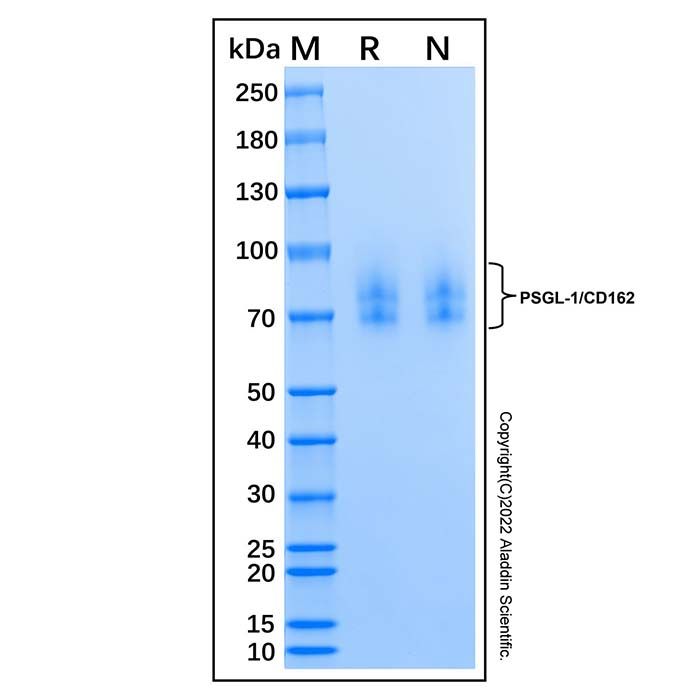
64.6-89.1 kDa, under reducing conditions; 65.9-88.6 kDa, under non-reducing conditions.
分子类型
蛋白质
产品线
生物产品
储存与运输
物理形态
冻干(Lyophilized)
储存缓冲液
Lyophilized from PBS, pH 7.4.
浓度
见COA
复溶
We recommend that this vial be briefly centrifuged prior to opening to bring the contents to the bottom. Reconstitute at 1.0 mg/mL in sterile distilled water. Stock solutions should be apportioned into working aliquots and stored at ≤ -20 °C. Further dilutions should be made in appropriate buffered solutions.
储存条件
-20°C储存,避免反复冻融
运输条件
超低温运输
稳定性与储存
-20℃保存 12个月;复溶后建议分装,避免反复冻融。
图片
Recombinant Human PSGL-1/CD162 Protein (rp228984) - SDS-PAGE 3 μg/lane of Recombinant Human PSGL-1/CD162 Protein was resolved with SDS-PAGE under reducing (R) and non-reducing (N) conditions and visualized by Coomassie® Blue staining, showing a band at 64.6-89.1 kDa under reducing conditions and 65.9-88.6 kDa under non-reducing conditions. The presence of two bands under non-reducing and reducing conditions may be due to the protein existing in two different conformations in this state (Uniprot: Q14242) .

 ZJ25F0927641


 危险品化学品经营许可证(带存储)