dJ576K7.1 (FK506 binding protein 12 rapamycin associated protein 1) | FK506 binding protein 12 rapamycin associated protein 1 | FK506 binding protein 12 rapamycin associated protein 2 | FK506 binding protein 12 rapamycin complex associated protein 1 | FK5
规格或纯度
无载体,His标签,≥90%(SDS-PAGE),见COA
生化机理
The protein encoded by this gene belongs to a family of phosphatidylinositol kinase-related kinases. These kinases mediate cellular responses to stresses such as DNA damage and nutrient deprivation. This protein acts as the target for the cell-cycle arrest and immunosuppressive effects of the FKBP12-rapamycin complex. The ANGPTL7 gene is located in an intron of this gene. Kinase subunit of both mTORC1 and mTORC2, which regulates cell growth and survival in response to nutrient and hormonal signals. mTORC1 is activated in response to growth factors or amino-acids. Growth factor-stimulated mTORC1 activation involves AKT1-mediated phosphorylation of TSC1-TSC2, which leads to the activation of the RHEB GTPase that potently activates the protein kinase activity of mTORC1. Amino-acid-signaling to mTORC1 requires its relocalization to the lysosomes mediated by the Ragulator complex and the Rag GTPases. Activated mTORC1 up-regulates protein synthesis by phosphorylating key regulators of mRNA translation and ribosome synthesis. mTORC1 phosphorylates EIF4EBP1 and releases it from inhibiting the elongation initiation factor 4E (eiF4E). mTORC1 phosphorylates and activates S6K1 at 'Thr-421', which then promotes protein synthesis by phosphorylating PDCD4 and targeting it for degradation. Phosphorylates MAF1 leading to attenuation of its RNA polymerase III-repressive function. mTORC2 is also activated by growth. factors, but seems to be nutrient-insensitive. mTORC2 seems to function upstream of Rho GTPases to regulate the actin cytoskeleton, probably by activating one or more Rho-type guanine nucleotide exchange factors. mTORC2 promotes the serum-induced formation of stress-fibers or F-actin. mTORC2 plays a critical role in AKT1 'Ser-473' phosphorylation, which may facilitate the phosphorylation of the activation loop of AKT1 on 'Thr-308' by PDK1 which is a prerequisite for full activation. mTORC2 regulates the phosphorylation of SGK1 at 'Ser-422'. mTORC2 also modulates the phosphorylation of PRKCA on 'Ser-657'.
Post-translational: Autophosphorylates when part of mTORC1 or mTORC2 (PubMed:15467718, PubMed:20022946, PubMed:9434772). Phosphorylation at Ser-1261, Ser-2159 and Thr-2164 promotes autophosphorylation (PubMed:19487463). Phosphorylated at Ser-2448 by RPS6KB1 (PubMed:15899889, PubMed:15905173, PubMed:19145465). Phosphorylation in the kinase domain modulates the interactions of MTOR with RPTOR and AKT1S1/PRAS40 and leads to increased intrinsic mTORC1 kinase activity (PubMed:15905173, PubMed:19145465, PubMed:21576368). Phosphorylation at Ser-2159 by TBK1 in response to growth factors and pathogen recognition receptors promotes mTORC1 activity (PubMed:29150432). Phosphorylation at Ser-2159 by TBK1 in response to EGF growth factor promotes mTORC2 activity, leading to AKT1 phosphorylation and activation (By similarity). Phosphorylation at Thr-2173 in the ATP-binding region by AKT1 strongly reduces kinase activity (PubMed:24247430).Ubiquitinated at Lys-2066 by the SCF(FBXO22) complex via 'Lys-27'-linked ubiquitination prevents mTORC1 substrate recruitment.
Store at -20℃ for 12 months. Upon receipt, it is recommended to aliquot. Avoid freeze/thaw cycle.
图片
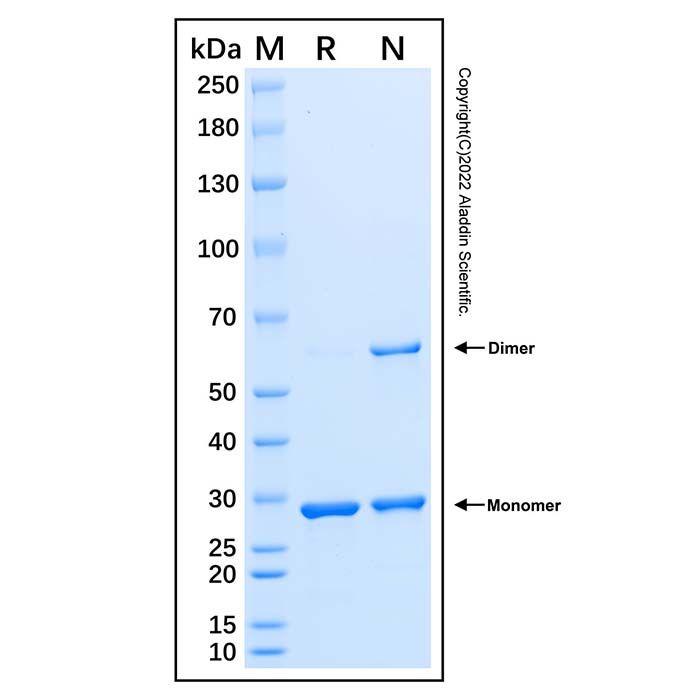
Recombinant Human mTOR Protein (rp229355) - SDS-PAGE 3 μg/lane of Recombinant Human mTOR Protein was resolved with SDS-PAGE under reducing (R) and non-reducing (N) conditions and visualized by Coomassie® Blue staining, showing a band at 28.8 kDa under reducing conditions and 29.4 & 60.6 kDa under non-reducing conditions. Under specific non-physiological conditions, including high concentrations or particular buffer environments, mTOR monomers have the potential to form non-covalent dimers or higher-order oligomers through non-covalent interactions (Uniprot ID:P42345).

 ZJ25F0928097


 危险品化学品经营许可证(带存储)