Receptor interacting protein 3 | Receptor interacting serine threonine kinase 3 | Receptor interacting serine/threonine protein kinase 3 | Receptor-interacting protein 3 | Receptor-interacting serine/threonine-protein kinase 3 | RIP 3 | RIP like protein k
规格或纯度
无载体,His标签,≥90%(SDS-PAGE),见COA
生化机理
Necroptosis is a form of programmed necrotic cell death that is rapidly emerging as an important pathophysiological pathway in numerous disease states. Necroptosis is dependent on receptor-interacting protein kinase 3 (RIPK3), a protein shown to play an important role in experimental models of critical illness. RIPK3 promotes kidney tubular injury via mitochondrial dysfunction. The FAO-dependent RIPK3 mediates pathogenesis of acute lung injury.
Post-translational: (Microbial infection) Proteolytically cleaved by S.flexneri OspD3 within the RIP homotypic interaction motif (RHIM), leading to its degradation and inhibition of necroptosis.RIPK1 and RIPK3 undergo reciprocal auto- and trans-phosphorylation (PubMed:19524513).Autophosphorylated following interaction with ZBP1 (By similarity).
Phosphorylation of Ser-199 plays a role in the necroptotic function of RIPK3 (PubMed:11734559, PubMed:19524512).Autophosphorylates at Ser-227 following activation by ZBP1: phosphorylation at these sites is a hallmark of necroptosis and is required for binding MLKL (PubMed:22265413).Phosphorylation at Thr-182 is important for its kinase activity, interaction with PELI1 and PELI1-mediated 'Lys-48'-linked polyubiquitination and for its ability to mediate TNF-induced necroptosis (PubMed:29883609).Polyubiquitinated with 'Lys-48' and 'Lys-63'-linked chains by BIRC2/c-IAP1 and BIRC3/c-IAP2, leading to activation of NF-kappa-B (PubMed:21931591).Polyubiquitinated with 'Lys-48'-linked chains by PELI1 leading to its subsequent proteasome-dependent degradation. Ubiquitinated by STUB1 leading to its subsequent proteasome-dependent degradation (PubMed:29883609).Deubiquitinated by USP22 (PubMed:33369872).
We recommend that this vial be briefly centrifuged prior to opening to bring the contents to the bottom. Reconstitute at 0.5 mg/mL in sterile distilled water. Stock solutions should be apportioned into working aliquots and stored at ≤ -20 °C. Further dilutions should be made in appropriate buffered solutions.
储存条件
-20°C储存,避免反复冻融
运输条件
超低温运输
稳定性与储存
-20℃保存 6个月;复溶后建议分装,避免反复冻融。
图片
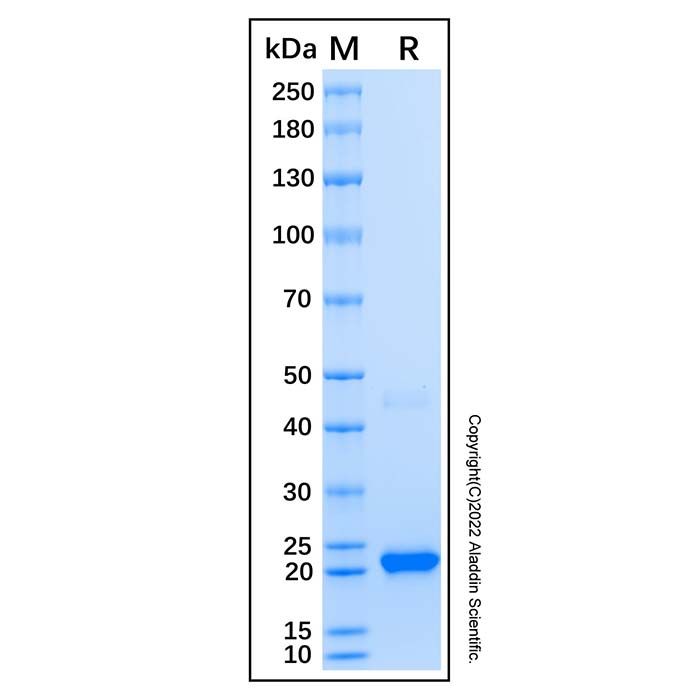
Recombinant Human RIPK3 Protein (rp229358) - SDS-PAGE
3 μg/lane of Recombinant Human RIPK3 Protein was resolved with SDS-PAGE under reducing (R) and visualized by Coomassie® Blue staining, showing a band at 21.9 kDa.



 危险品化学品经营许可证(带存储)