CCN2 | CCN2IGFBP-8 | connective tissue growth factor | CTGF | CTGRP | Fisp12 | HCS24 | Hypertrophic chondrocyte-specific protein 24 | IBP-8 | IGF-binding protein 8 | IGFBP-8 | IGFBP8CCN family member 2 | Insulin-like growth factor-binding protein 8 | MGC1
规格或纯度
无载体,His标签,≥85%(SDS-PAGE),见COA
生化机理
Connective Tissue Growth Factor (CTGF), also known as CCN2, is a 36-38 kDa member of the CCN (CYR61/CTGF/NOV) family of secreted matricellular proteins. Like other CCN proteins, mature human CTGF consists of IGF-binding protein domain, a vWF-C domain, a TSP-1 domain, and a cysteine knot heparin-binding domain. Human CTGF shares 94% amino acid (aa) sequence identity with mouse and rat CTGF. Alternative splicing generates an additional isoform with a 27 aa deletion within the TSP-1 domain. CTGF promotes cell adhesion through interactions with a range of cell surface molecules including heparan sulfate proteoglycans (HSPG), LRPAP, and Integrins alpha M, alpha V beta 3, alpha 6 beta 1, alpha IIb beta 3. It also binds to and regulates signaling through the Wnt receptors LRP6 and Frizzled-8 and the NGF receptors TrkA and NGF R. In addition, CTGF binds directly to BMP-4, TGF-beta 1, TGF-beta 2, and VEGF 165. It blocks BMP-4 and VEGF induced responses but enhances TGF-beta induced responses. Within VEGF complexes, CTGF can be degraded by a variety of proteases, resulting in restoration of angiogenic activity. CTGF promotes fibroblast differentiation from mesenchymal stem cells and their production of type I Collagen and Tenascin C. It promotes chondrocyte proliferation and cartilage matrix synthesis. CTGF is expressed in vascular mural and endothelial cells (EC) during development and promotes pericyte-EC association and angiogenesis. It is expressed in the cerebral cortex and olfactory bulb and plays an important role in nervous system development.
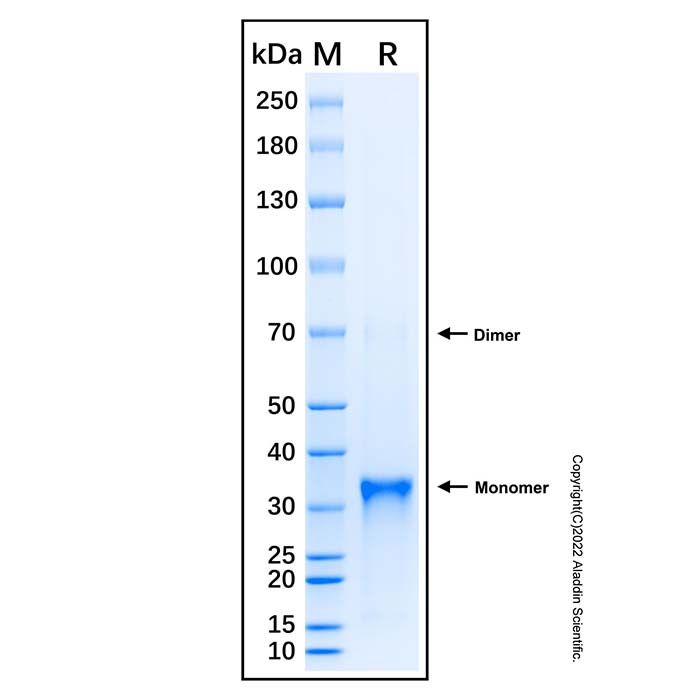
Recombinant Human CTGF/CCN2 Protein (rp301928) - SDS-PAGE 3 μg/lane of Recombinant Human CTGF/CCN2 Protein was resolved with SDS-PAGE under reducing (R) conditions and visualized by Coomassie® Blue staining, showing a band at 33.4 & 70.3 kDa under reducing conditions. CTGF (Connective Tissue Growth Factor) contains multiple cysteine residues that readily form both intramolecular and intermolecular disulfide bonds (Uniprot ID: P29279).

 ZJ25F0927987


 危险品化学品经营许可证(带存储)