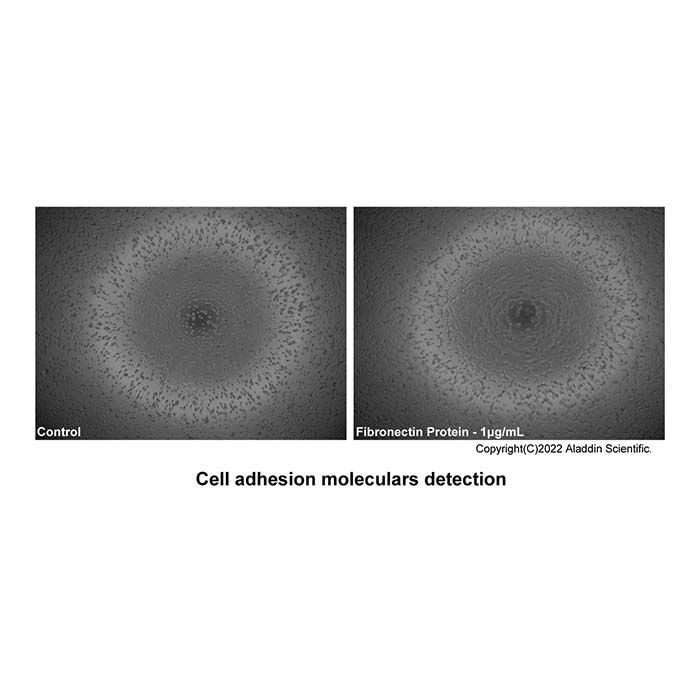
Measured by the ability of the immobilized protein to support the adhesion of NIH‑3T3 mouse embryonic fibroblast cells.The ED50 for this effect is 1.0 μg/mL.
Fibronectin (FN) is a glycoprotein component of the extracellular matrix of the extracellular matrix (ECM) with roles in embryogenesis, development, and wound healing. More recently, FN has emerged as player in platelet thrombus formation and diseases associated with thrombosis including vascular remodeling, atherosclerosis, and cardiac repair following a myocardial infarct. Each monomer of FN consists of three types of homologous repeating units, that is 12 type I repeats, two type II repeats and 15-17 type III repeats. The occurrence of multiple isoforms results from alternative mRNA splicing of the ED-A, ED-B and III-CS regions, and subsequent post-translational modification. As an ECM component and one of the primary cell adhesion molecules, Fibronectin can be a ligand for fibrin, heparin, chondroitin sulfate, collagen/gelatin, as well as many integrin receptors through which FN mediates the variety of cellular signaling pathways. The study of solid human tumors showed among the early signs of malignant transformation the fragmentation of pericellular FN, concommitent with the increase of its production by the peritumoral stroma. These results should encourage further investigations concerning the potential importance of Fn production and breakdown during cancer progression. FN1 expression has been described to increase significantly from the morula towards the early blastocyst stage, suggesting that FN1 may also be involved in early blastocyst formation. The fragment 2 of FN comprises the first 7 FN type III repeats and is suggested to be important for self association during fibril growth via the key module III2.
Post-translational: Sulfated. It is not known whether both or only one of Thr-2155 and Thr-2156 are/is glycosylated. Forms covalent cross-links mediated by a transglutaminase, such as F13A or TGM2, between a glutamine and the epsilon-amino group of a lysine residue, forming homopolymers and heteropolymers (e.g. fibrinogen-fibronectin, collagen-fibronectin heteropolymers). Phosphorylated by FAM20C in the extracellular medium. Proteolytic processing produces the C-terminal NC1 peptide, anastellin. Some lysine residues are oxidized to allysine by LOXL3, promoting fibronectin activation and matrix formation. Serotonylated on Gln residues by TGM2 in response to hypoxia.
生物活性
Measured by the ability of the immobilized protein to support the adhesion of NIH‑3T3 mouse embryonic fibroblast cells.The ED50 for this effect is 1.0 μg/mL.
31.1 & 33.1 kDa, under reducing conditions; 30.8 & 32.8 kDa, under non-reducing conditions.
分子类型
蛋白质
产品线
生物产品
储存与运输
物理形态
冻干(Lyophilized)
储存缓冲液
Lyophilized from PBS, pH 7.4.
浓度
见COA
复溶
We recommend that this vial be briefly centrifuged prior to opening to bring the contents to the bottom. Reconstitute at 0.5 mg/mL in sterile distilled water. Stock solutions should be apportioned into working aliquots and stored at ≤ -20 °C. Further dilutions should be made in appropriate buffered solutions.
储存条件
-20°C储存,避免反复冻融
运输条件
超低温运输
稳定性与储存
-20℃保存 12个月;复溶后建议分装,避免反复冻融。
图片
Recombinant Human Fibronectin Protein (rp305420) - Protein
Bioactivity
Measured by the ability of the immobilized protein to support the adhesion of NIH‑3T3 mouse embryonic fibroblast cells.The ED50 for this effect is 1.0 μg/mL.
Recombinant Human Fibronectin Protein (rp305420) - SDS-PAGE
3 μg/lane of Recombinant Human Fibronectin Protein was resolved with SDS-PAGE under reducing (R) and non-reducing (N) conditions and visualized by Coomassie® Blue staining, showing the bands at 31.1 & 33.1 kDa under reducing conditions and 30.8 & 32.8 kDa under non-reducing conditions.
FN1 expression has been described to increase significantly from the morula towards the early blastocyst stage, suggesting that FN1 may also be involved in early blastocyst formation. By alternative splicing at 3 defined regions, different FN1 isoforms are generated, each with a unique biological function. (PMID: 19126199).

 ZJ25F1230554


 危险品化学品经营许可证(带存储)